

Jun 07, 2025·8 min
Samsung Display OLED Scale & Yields: Why Phones Feel Premium
Learn how OLED production scale and yield rates shape brightness, uniformity, durability, and cost—driving the premium experience in top smartphones.
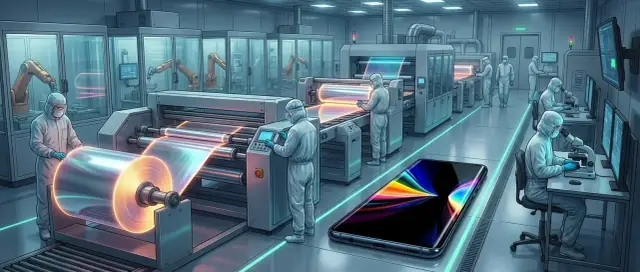
Learn how OLED production scale and yield rates shape brightness, uniformity, durability, and cost—driving the premium experience in top smartphones.
When people talk about “premium” phone displays, they often jump straight to specs—peak brightness, refresh rate, or HDR badges. But a lot of what you experience day to day is decided earlier, inside the factory, through two unglamorous ideas: scale and yield.
Scale is how many usable panels a supplier can produce consistently, week after week. It’s not just about big buildings or lots of machines. Real scale means the process is stable enough to ramp for a major launch without quality drifting or deliveries slipping.
For a phone buyer, scale shows up as:
Yield is the share of panels that pass inspection and can ship.
If a factory starts 100 panels and only 70 meet requirements, yield is 70%. The other 30 aren’t just “wasted”—they may need rework, get downgraded, or get scrapped. All of that affects cost, timing, and consistency.
OLED panels are built from many ultra-thin layers and delicate steps that must line up perfectly. Small variations—tiny particles, uneven deposition, slight misalignment—can create issues you might notice later, like uneven brightness, color tinting, or early pixel wear.
The key idea: display performance isn’t only a design choice; it’s also a manufacturing outcome.
This article focuses on the mechanics of how OLED manufacturing scale and yield influence real phones. It’s not about rumors or brand drama—it’s about why suppliers like Samsung Display invest heavily in processes that make high-quality panels repeatable at volume.
An OLED panel looks like a single sheet of glass, but it’s really a stack of thin layers made in a clean room where dust is the enemy. Think of it as a sandwich where every layer has a job—and a tiny mistake in any layer can show up as a visible flaw.
Most smartphone OLEDs are built on a substrate (often glass or flexible plastic). On top of that sits the TFT backplane—a grid of microscopic transistors and wiring that turns each pixel on and off and controls how much current it gets.
Next are the emissive organic layers. These are the materials that actually produce light when electricity passes through them. Because each pixel has sub-pixels (typically red, green, and blue), the panel needs very precise patterning so the right material lands in the right place.
Finally, there’s encapsulation: a protective barrier that seals the OLED materials from oxygen and moisture, which can degrade them quickly.
At a high level, manufacturers deposit organic materials using methods like evaporation (vaporizing material and letting it settle) or, in some approaches, printing. For many phone panels, evaporation relies on a fine metal mask (FMM)—a super-thin stencil that helps place materials accurately at pixel scale.
A speck of contamination, a slight misalignment, or a weak transistor can create dead pixels, stuck pixels, uneven brightness, or color tinting. Because OLED pixels emit their own light, inconsistencies don’t get “hidden” by a backlight.
As screens pack in more pixels and bezels shrink, features get smaller and tolerances tighten. That means more steps where alignment and cleanliness must be near-perfect—making manufacturing (and high yield) much harder than the spec sheet suggests.
A phone display can look incredible on a spec sheet—peak brightness, wide color, high refresh rate. But the number that often decides whether you can actually buy that phone (and at what price) is yield.
Yield rate is the share of panels that pass all checks at the “factory gate.” A “good panel” isn’t just one that lights up. It must meet strict tolerances for:
If 1,000 panels are made and 850 pass, that’s an 85% yield. The other 150 aren’t “almost fine”—many can’t be sold for premium phones, and some can’t be reworked at all.
When yields are high, a supplier can promise volume because most of what they make becomes sellable product. When yields dip, the same factory output produces fewer usable panels, which can:
That’s why defect rates can matter more than a headline spec. A panel that’s theoretically amazing but hard to produce consistently won’t show up in millions of phones on schedule.
Early ramp yields are commonly lower when a panel design changes—new materials, thinner stacks, new hole layouts, tighter bezels, or different camera cutouts. Each change adds process risk, and variations that were tolerable before may suddenly cause failures.
A few lab-made samples can be tuned and hand-selected to look perfect. Mass production is different: the goal is repeatability at scale, across countless panels, shifts, and equipment cycles. Yield is the scoreboard for that reality.
When people talk about “scale” at Samsung Display, they’re not just talking about how many panels a factory can make. They’re talking about how many panels it can make that meet spec, week after week. That combination—capacity plus steady yields—is what turns cutting-edge OLED into something brands can buy at predictable prices.
OLED panels are built through many steps. If a panel fails late in the process, you’ve already spent material, machine time, and labor on it. Higher yields mean fewer panels get rejected, which reduces scrap and rework.
Panel cost isn’t only “materials + margin.” It also includes the cost of all the panels that didn’t pass. As yields rise, that hidden cost shrinks—so suppliers can quote lower prices, or at least avoid sudden spikes.
For many phones, the display is one of the most expensive components in the smartphone bill of materials. If panel pricing stabilizes, product teams can hold the line on overall BOM, which reduces pressure to:
Steady yields also make supply planning easier: brands can commit to larger launch volumes without fearing last-minute shortages.
Newer OLED features—higher peak brightness, thinner borders, under-display camera designs—often start with lower yields. If yields are constrained, suppliers may prioritize a small number of flagship models, keeping those features expensive and less available until manufacturing catches up.
When people say a phone screen “looks premium,” they’re usually reacting to a few very specific outcomes. Many of them tie back to yield—how often a panel meets tight thresholds without needing rework or being scrapped.
Uniformity issues are often easiest to spot on low-brightness grays (think dark mode backgrounds). Yield loss here tends to show up as:
These aren’t “spec sheet” problems—they’re perception problems. Even slight non-uniformity can make a display feel cheaper, because your eyes read it as inconsistency.
High peak brightness is a headline feature, but it’s constrained by physics and by manufacturing consistency. To hit brightness targets without overheating or draining the battery too fast, the panel has to operate efficiently and predictably.
If yields are lower, you can end up with wider performance spread: some panels can sustain higher brightness cleanly, while others must be tuned more conservatively to stay within heat and power limits. That tuning can reduce real-world “pop,” especially outdoors.
Color quality isn’t just about calibration; it’s about how similarly millions of panels behave. A small shift in how OLED materials deposit or how layers align can push color balance off-center.
The hard part is not making one perfect display. It’s making the 1,000,000th display look like the 1st—so two phones bought months apart still match.
Modern OLED stacks often integrate touch layers and use very thin cover materials. That helps with slim designs and responsiveness, but it adds yield risk:
When yields are high, brands can ship screens that look consistently bright, even, and color-stable—exactly the “premium” feel people notice immediately.
OLED durability isn’t only about how careful you are with your phone—it’s also the result of manufacturing choices that influence how the panel ages. Scale helps top suppliers learn faster, but reliability still depends on the details.
“Burn-in” (more accurately, uneven aging) is partly a materials story. Different organic layers and blue-emitter strategies age at different rates, so suppliers tune the stack to reduce visible drift over time.
Manufacturing also bakes in burn-in countermeasures through compensation. Panels ship with calibration data and algorithms that adjust driving signals as pixels age. The more consistent the manufacturing process, the easier it is to apply compensation evenly—less guesswork, fewer panels that age oddly.
OLED materials don’t like oxygen or moisture. Long-term reliability depends heavily on encapsulation (thin-film barriers, adhesives, sealing methods) that prevent tiny ingress over years of heat cycles, pockets, and humid bathrooms.
When sealing quality varies, early failures show up as dead spots, edge issues, or rapid brightness drop. High-volume production lines typically add tighter process controls and more frequent checks so “weak seals” don’t slip through.
Premium phones chase thin bezels and lighter stacks, but drop resistance often benefits from thicker cover glass, stronger support layers, and more protective bonding. Those choices can slightly reduce peak brightness or increase cost, so manufacturers balance protection against weight and visual design.
Suppliers screen panels for defects that only appear after stress: heat, current, and repeated cycling. Better screening and tighter thresholds don’t eliminate wear, but they do reduce the chance of getting a panel that fails in the first months—exactly the kind of reliability difference buyers feel but can’t see on a spec sheet.
Brightness is one of the easiest specs to market, but it’s also one of the hardest to deliver consistently across millions of panels. When Samsung Display (and any OLED maker) talks about pushing brightness, they’re not only chasing a number—they’re managing heat, power, aging, and how many panels can reliably meet that target.
A phone can hit an impressive peak brightness for short bursts (for example, a small HDR highlight or a quick outdoor boost). Sustained brightness is what you get when more of the screen stays bright for longer—like a sunny day while using maps, scrolling a bright web page, or watching HDR scenes with lots of bright content.
Sustained brightness is limited by temperature and power, not just the OLED material. If the panel or phone gets too hot, the system will pull brightness down to protect the display and battery.
Driving OLED harder means higher current. Higher current means more heat, and heat accelerates aging. That’s why panel design, the phone’s thermal stack, and power delivery all affect real-world brightness. Two phones can use similar-looking panels yet behave differently outdoors depending on how effectively they move heat away and how aggressively they manage power.
Not every manufactured panel performs identically. To ship a “premium” brightness experience at scale, manufacturers often sort output into performance bands (bins). The highest-brightness, best-efficiency bins are the toughest to produce in large quantities—so yield constraints can cap how many top-tier panels are available for flagship models.
For users, this shows up as better outdoor readability, fewer sudden brightness drop-offs, and more convincing HDR: highlights that pop without the whole screen dimming a moment later.
A panel design can look like a small tweak on a spec sheet—slightly larger, a tighter radius on the corner, a new hole for the selfie camera—but on the factory floor it often behaves like a brand-new product.
OLED production is tuned for stability: once a line is dialed in, yields rise and costs fall. Change the shape or structure, and the process has to be re-balanced.
Every panel size has its own mechanical stresses, material flow, and sensitivity to tiny particles. Moving from one diagonal to another, changing aspect ratio, or pushing a display closer to the edges can shift where defects show up. Even when the underlying technology is the same, the manufacturing recipe (timings, temperatures, deposition uniformity) may need re-qualification.
Premium design trends can be yield-unfriendly:
Foldable OLEDs aren’t just “a bigger screen.” They typically require extra layers, specialized encapsulation, hinge-area reinforcement, and strict control of thickness and flexibility. Each added step is another chance for contamination, misalignment, micro-cracking, or uneven curing—problems that may only appear after repeated folding.
Brands plan around how fast yields can climb from early runs to mass production. That’s why first-wave devices may launch in fewer regions, with tighter supply, or with higher prices. As the panel maker’s ramp stabilizes, availability improves—and the same design often becomes easier to build consistently.
Most phone brands would love to multi-source displays—buy the same panel from two or more suppliers—because it reduces risk and improves negotiating power. “Single-sourcing” is the opposite: one supplier provides most (or all) of a model’s OLED panels.
In practice, many flagship phones end up closer to single-sourced, especially early in a product cycle. The reason is simple: only a handful of suppliers can deliver the combination of volume, consistent yield, tight quality control, and the exact design a brand wants on a fixed schedule.
OLED fabs run close to full utilization. If one major supplier hits a capacity constraint—equipment downtime, slower-than-expected yields on a new panel, or a surge in orders—multiple brands can feel it at once.
That can show up as:
Even if another supplier has spare capacity, brands can’t simply “swap” panels. Each panel must pass qualification: mechanical fit, power draw, touch integration, color calibration, drop/heat tests, and long-run reliability checks. Then the factory line needs tuning and new calibration targets. That cycle can take months, not weeks.
Because switching takes time, product teams plan for supply risk early: reserving capacity well in advance, keeping a second source in qualification as insurance, or designing the phone so a near-equivalent panel can be used with minimal changes. When this planning is done well, customers experience it as something boring but valuable: phones that are available, consistent, and “premium” on day one.
A premium OLED doesn’t happen just because the design is good. It happens because the factory can repeatedly ship panels that fall within tight limits—day after day, across millions of units. That consistency is mostly a quality-control story.
OLED factories typically stack several checkpoints, each catching a different class of problems:
The goal isn’t perfection—it’s predictability. A display that looks great at the factory but drifts quickly in the field is a warranty problem waiting to happen.
Even within spec, panels vary. Manufacturers often bin panels into groups based on measured brightness, color balance (white point), and uniformity. Two phones can use panels from different bins and still pass, yet one might look slightly warmer, slightly brighter, or more uniform at low brightness.
Quality control relies on defined tolerances: how far color can deviate, how much brightness can vary across the screen, and how visible uniformity patterns are under test scenes.
Tighter tolerances usually mean more panels get rejected or reworked—raising cost—but they reduce the odds users notice issues.
Testing choices are business choices. Better screening lowers return rates, cuts warranty spend, and protects brand reputation. When a panel supplier can hold bins steady over time, product teams can ship consistent phones—and users stop playing “panel lottery.”
Yield is usually discussed like a finance metric—how many “good” panels you get for the money you spend. But it also shapes the waste footprint of OLED production, because every panel that doesn’t ship still consumed materials, time, and energy.
When a panel fails inspection, manufacturers generally have two options:
Rework is better than scrapping a finished panel, but it’s not “free.” It adds extra handling, extra process steps, and more rounds of testing—each one increasing the chance of new defects.
OLED panels rely on specialized materials (organic emitters, thin-film layers, encapsulation, polarizers). Even when a defect is small, the materials already deposited on that panel can’t always be recovered.
A simple way to think about it: if you need 1 million shipped panels, a higher-yield line needs fewer total panels started to reach that target. Fewer starts means less material wasted per shipped device.
OLED manufacturing isn’t a single “print and done” step. It’s a chain of precise processes—vacuum deposition, patterning, encapsulation, inspection—often performed in tightly controlled environments. Each extra pass (from rework or extended troubleshooting) consumes additional energy and extends equipment time.
So when yields improve, the sustainability benefit isn’t only about reducing scrap. It’s also about reducing the number of repeated steps required per sellable panel.
Better yields can mean less waste and more consistent supply. That combination helps brands avoid last-minute design compromises, substitutions, or rushed ramp-ups—choices that can create their own inefficiencies.
A phone can list “OLED” (or even the same marketing label) and still look or age differently from another model. That’s because the label doesn’t tell you how tight the manufacturing tolerances were, which materials stack was used, how aggressively it’s driven, or how strict the supplier’s binning and quality control were.
Two “same type” panels can ship with different brightness limits, different uniformity, and different long‑term stability depending on process maturity and how hard the brand pushes for thinness, high refresh, or peak nits.
When you’re deciding between models—or setting requirements for a product—ask questions that map to real user outcomes:
You can learn a lot with simple, repeatable checks:
If you’re sourcing at scale, define acceptance criteria beyond the spec sheet: allowable tint range, uniformity thresholds, minimum sustained brightness, and burn-in mitigation behavior. Also plan for supply variability—qualifying more than one option (or at least more than one process node) reduces surprises.
This is also where internal tooling matters. Teams that track yields, bins, returns, and supplier performance often end up building lightweight apps and dashboards for planning and QA workflows. If you want to spin up those tools quickly without a long dev cycle, Koder.ai can help: it’s a vibe-coding platform where you describe what you need in chat and generate web apps (React), backends (Go + PostgreSQL), and even mobile apps (Flutter)—with options like planning mode, snapshots/rollback, deployment/hosting, and source code export.
If you’re building a buying guide or product requirements, related reading: /blog and /pricing.
Scale is a supplier’s ability to produce large volumes consistently over time, not just their maximum capacity.
For buyers, scale usually means:
Yield is the percentage of panels that pass all factory inspections and can ship.
Example: if 1,000 panels are started and 850 meet spec, yield is 85%. Lower yield typically raises cost, tightens supply, and increases unit-to-unit variation.
OLED stacks involve ultra-thin layers, extremely clean processes, and tight alignment (often with fine metal masks).
Small errors—particles, misalignment, uneven deposition—can turn into visible issues like tint shifts, blotchy grays (mura), or early pixel wear.
When yields dip, the same factory output produces fewer usable panels, which can lead to:
High yield helps brands plan bigger launches with fewer surprises.
The most common “premium vs not” differences are things you can see:
These are often manufacturing-outcome problems, not just “settings.”
Try simple, repeatable checks:
If defects bother you, exchange early—return windows are your best leverage.
“Peak” brightness is a short burst (small highlights, brief outdoor boost). Sustained brightness is what matters for maps, web pages, and long outdoor use.
Sustained brightness is limited by heat and power, so two phones with similar peak-nit marketing can behave very differently after a few minutes in the sun.
Not every produced panel performs identically, so suppliers often bin panels by measured brightness, color balance, and uniformity.
Two phones can both be “within spec” yet look slightly different (warmer/cooler whites, better/worse low-gray uniformity). Tighter tolerances reduce this, but usually increase cost.
Burn-in (uneven aging) is influenced by materials and process consistency.
Manufacturers mitigate it with:
Consistent manufacturing makes compensation more predictable across units, reducing odd early-life behavior.
Yield isn’t just cost—it’s waste. Low yield means more panels are scrapped or sent through extra rework loops, consuming more materials and energy per shipped display.
Higher yield generally means fewer “starts” are needed to ship the same number of phones, reducing scrap and repeated processing.