

Jan 15, 2026·7 min
Reading Minutes Challenge Leaderboard for a Class Goal
Build a reading minutes challenge leaderboard that helps students log time, see class progress, and stay motivated with clear rules and a shared goal.
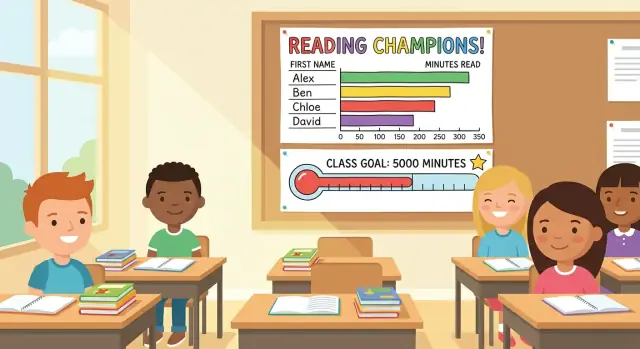
Build a reading minutes challenge leaderboard that helps students log time, see class progress, and stay motivated with clear rules and a shared goal.
Most classes hit the same wall with reading challenges: it’s hard to track minutes fairly, and the excitement fades after the first week. When students only hear “read more,” it stays vague. A visible record makes reading concrete, and it cuts down on arguments because everyone can see what was logged and when.
A shared class goal also feels different than a race for first place. Instead of “Who’s the best reader?”, the message becomes “Can we do this together?” That matters for confidence, especially for students who read more slowly, are learning English, or are still building stamina. They can still help the team by showing up consistently. The point isn’t ranking kids. It’s making progress visible.
What students need to see each day is simple: the class total, their own contribution, the time window (this week, this month, or the full challenge), and a quick celebration when the class hits a milestone.
This works best when reading already happens regularly: a daily 10 to 20 minute independent reading block, reading centers, or a nightly routine at home. It fits upper elementary through middle school, and it can work in early grades if minutes are logged with support (for example, “read with an adult” counts). Keep the timeframe short enough to feel winnable. Two to four weeks is usually enough to build a habit without the goal feeling far away.
Example: A fifth-grade class sets a goal of 2,000 minutes in three weeks. Each morning, students add last night’s minutes, and the teacher updates a big total on the board. On Friday, the class sees they’re 300 minutes ahead. That one number changes the mood: students start reminding each other to log minutes, not because they fear losing, but because they want to reach the shared finish line.
A reading challenge only feels fair when everyone agrees on what “minutes” mean. Decide what counts, what doesn’t, and how you’ll handle gray areas before you start. It prevents debates later and keeps the focus on reading.
Minutes are simple across different books and reading levels. They reward consistency and habit-building. The downside is honesty and pacing: two students can log the same time but read very different amounts.
Pages are easier to verify and can feel more concrete, but they can punish students who choose harder books, graphic novels with fewer words per page, or larger print.
A practical middle ground: track minutes as the main score, and use pages as optional “proof” when you need it (for example, “Chapter 3-4” or a page range).
Many classes do best when the display emphasizes the group goal rather than a race between kids. You can separate what students see every day from what you track privately.
Common options:
Privacy matters. If public numbers stress students, keep individual totals private and let students choose whether to share. You can still recognize effort with “most consistent reader” or “five reading days this week” without showing exact minutes.
Write clear rules so students don’t spend the challenge arguing edge cases.
A rule that keeps it simple: if the student can give a one-sentence recap, the minutes count.
A class challenge runs smoothly when the rules fit on one small poster and students can repeat them back. If the rules feel fuzzy, tracking turns into debate instead of reading.
Weekly resets feel fresh and help younger students who need quick wins. Monthly or a four to six week cycle works well if you want deeper habits. Whatever you pick, keep the reset day consistent (for example, every Friday after lunch) so students know when totals lock.
Choose a goal that’s a stretch but still reachable. You can describe it in kid-friendly terms (“We’re trying to read the length of three chapter books together”), but measure it in minutes so it stays simple.
To keep effort steady, add a clear minimum expectation in numbers students can picture: “10 minutes a day” or “50 minutes a week.” If some students read far above the minimum, celebrate it, but keep the class goal focused on everyone contributing.
These rules are usually easy to follow:
Add an honesty rule and a light way to verify. You don’t need to “catch” kids. Simple checks work: a book title and page number, a one-sentence retell, or a partner check-in. Example: every Friday, each student shares what they read most this week and one detail they remember. It keeps the challenge honest and builds real reading talk.
The best tracking method is the one you’ll keep up with on a busy week. A leaderboard only works if updates feel easy, not like extra homework.
Decide where progress will live: on paper, on the wall, or on a screen. Each has a hidden cost (printing, handwriting time, or device access), so choose what’s cheapest for your day.
If a tool won’t save time after week one, go simpler.
Too many fields slow kids down and create errors. Start with:
If it helps you make decisions, you can add “read at school / read at home,” but only if you’ll use it.
Daily logging is usually easiest because students remember what they read last night and you avoid big catch-up guesses. A simple routine: students log minutes during morning work, then you (or a student helper) update the class total once a day or twice a week.
Example: Maya records 15 minutes on Monday and 20 on Tuesday. She hands her log sheet to the “Leaderboard Captain” on Wednesday, who adds 35 minutes to her total while you take attendance. Updates stay predictable, and the leaderboard doesn’t become a constant distraction.
If you’re using self-report, decide upfront how you’ll handle mistakes: quick corrections, no blame, and a reminder that the goal is honesty and practice, not perfect numbers.
A leaderboard works best when it feels like routine. Logging should be fast, totals should be visible, and progress should be something the class can celebrate together.
After day one, aim for a rhythm where students can log in under 30 seconds. For younger students, you might collect minutes by table groups. For older students, a quick self-report with occasional spot checks usually works.
Keep celebrations simple and low-cost. If your goal is 2,000 minutes, celebrate at 500, 1,000, and 1,500 so students feel progress even if they joined late or had a busy week.
A few reward ideas that avoid food and big prizes:
If you want a digital tracker, keep the display big and clear. Some teachers build a simple classroom tracker screen so updating totals feels like a few taps instead of rewriting the board.
A leaderboard can motivate, but it can also send the message that only the strongest readers matter. The fix is to show progress in more than one way. Keep the class goal front and center, and treat individual progress as a side story.
Mix personal streaks with class milestones so everyone can contribute. A student who reads 10 minutes a night might never catch the top reader, but they can keep a five-day streak that still pushes the class toward the shared total. If you display individual highlights, consider pairing “Class minutes toward the goal” with something like “Most improved this week” or “Most consistent this week.”
Small celebrations work better than one big prize at the end. They keep energy up without turning reading into a race. Let students suggest rewards and vote on a short list. If a suggestion won’t work, offer a similar option and explain why in one sentence.
To keep the focus on books, add optional sharing moments. A simple routine is a 30-second book talk spotlight once or twice a week. One student shares the title, one favorite line, and answers: “Who would like this book and why?” Keep it opt-in so quiet readers don’t feel put on the spot.
Most problems aren’t about reading. They’re about logging and how progress is shared.
Inflated minutes happen when “reading” isn’t defined the same way for everyone, or when logging is rushed. Fix it by using one clear rule and sticking to it: log only minutes spent with a book (or approved text), and round down to the nearest 5 minutes. A quick end-of-day check (30 seconds) prevents big errors from piling up.
Build a catch-up path that doesn’t feel like punishment. For example, allow one make-up day each week where students can add extra minutes from home reading or quiet reading time.
If your display highlights only top readers, some students will stop trying. Celebrate personal bests and class milestones (“We hit 1,000 minutes!”), not just rank.
If the chart is hard to read, or you update it once a week with no visible progress in between, students stop caring. Pick one simple visual and update it on a predictable schedule.
Quick fixes that prevent most headaches:
Example: If Maya reads 10 minutes today after missing yesterday, praise the comeback and add her minutes right away. That moment matters more than whether she’s in the top three.
A good challenge feels easy to join and easy to run. Before you launch, decide the few details that prevent most problems.
Post your “what counts” rule where everyone can see it. Keep it simple so students don’t argue edge cases. For example: “A reading minute is one minute spent reading a book or approved text with your eyes on the page and your brain on the story.” If audiobooks count, say so. If they don’t, say so.
Checklist:
Build the routine around your real day. If dismissal is rushed, logging at the end of class will fail. A safer time is right after independent reading, while books are still open.
Verification doesn’t need to feel like “gotcha.” A quick question like “What just happened in your chapter?” or “Read me your favorite line today” protects honesty and helps you learn what students enjoy.
Write your absence plan in plain words. Example: “If you’re out, you can make up minutes within one week, up to 20 minutes per day. Ask me for the make-up sheet.” Clear rules keep the focus on reading, not debating.
Picture a class of 24 students aiming for 10,000 minutes in four weeks. That’s about 417 minutes per student for the month, or roughly 21 minutes a school day if you count weekdays only. It sounds big, but the daily habit makes it manageable.
Keep the routine steady so it doesn’t become extra work:
Friday updates can be a good compromise. Students still see progress, and you’re not spending class time doing math every afternoon.
Make the display clear at a glance. Give each student a small bar (first name only, or a number) so they can track personal progress. Next to that, add one large class progress bar that fills toward 10,000. It stays a shared mission, not a race.
If a student reads less at home, don’t let that become a disadvantage. Count daily in-class minutes fully, and offer a short “bonus reading station” during arrival time, indoor recess, or choice time so they have a fair way to contribute.
Celebrate effort at milestones, not just the finish line:
When the challenge ends, don’t just erase the board. Take 10 minutes to learn what worked so the next round feels smoother.
A short exit ticket is enough: one thing that helped them read more, and one thing that made it harder. Some students love public progress. Others feel stressed when their name sits low on the board.
Prompts that stay quick:
Small tweaks beat a full redesign. If the goal felt impossible, lower the target or shorten the time window so the class hits wins more often. If students lost steam in week two, try a midpoint refresh where the class keeps a yearlong total privately, but the display starts fresh for the next sprint.
Also reconsider how you display progress. A big wall chart motivates some classes, while others do better with a private tracker and a weekly class update. You can keep the shared goal visible while making individual totals optional.
Don’t forget to save results. Even a simple monthly total helps students see growth over the year (“September: 220 minutes, October: 310 minutes”). That turns the challenge into a personal progress story, not just a competition.
If setup takes too much time, a small custom tracker can help. With Koder.ai (koder.ai), you can describe what you want in a chat prompt (student list, daily minutes, automatic totals, class goal bar) and generate a simple web app you can host for your class or export as source code. Snapshots and rollback can be useful if you want to adjust the tracker without losing what already works.
Pick a new theme for the next round so it feels fresh: a genre week, “mystery month,” reading buddies focused on kindness, or a class library spotlight where students recommend one book after logging minutes.
A class reading minutes leaderboard makes progress visible and specific. Instead of “read more,” students see a clear shared total, their contribution, and how close the class is to the goal, which keeps motivation up beyond the first week.
Start with a simple default: a minute counts when a student is actively reading (eyes on text) or actively listening to an approved audiobook and can explain what happened. If a student can give a one-sentence recap, count the minutes; if they can’t, don’t count them.
Minutes usually work better because they don’t punish students for choosing harder books, bigger print, or graphic novels. Pages can still be useful as optional context, like noting a chapter or page range, but minutes are the simplest shared score.
Default to showing the class total publicly and keeping individual totals private. If you want students to see personal progress, use personal milestones or streaks rather than ranking everyone by minutes, especially if your class gets anxious about comparisons.
Yes, but set one clear rule: they count only when the student is truly listening and can briefly retell what happened. If you’re worried it will replace independent reading, you can limit audiobook minutes or require some independent reading minutes each week.
Pick a goal that feels winnable in 2–4 weeks and connect it to a daily habit like 10–20 minutes. A good target is one that requires most students to show up consistently, not one that depends on a few super-readers carrying the total.
Use one predictable “log moment” each day, like the last two minutes of the reading block or morning work. Daily logging stays more accurate than weekly catch-ups because students remember last night’s reading and you avoid big guessed numbers.
Keep verification light and routine so it doesn’t feel like policing. A quick book title and page note, a one-sentence retell, or a short weekly share about what they read is usually enough to reduce inflated minutes without killing the fun.
Treat missed days as normal and offer a small catch-up window, like adding only yesterday’s minutes or allowing one make-up day per week. Praise the comeback, log it quickly, and keep the focus on returning to the habit, not on being perfect.
A simple custom tracker can save time if paper or a whiteboard becomes hard to maintain. With Koder.ai, you can describe the tracker you want in chat—student list, daily minutes, automatic totals, and a class goal bar—then run it as a basic app, export the source code, and use snapshots to safely tweak it later.