

Jan 06, 2026·8 min
Lunch Preference Poll for Small Groups That Ends the Chat Loop
Set up a lunch preference poll to collect dietary needs fast, narrow choices, and pick a place without long group chats or confusion.
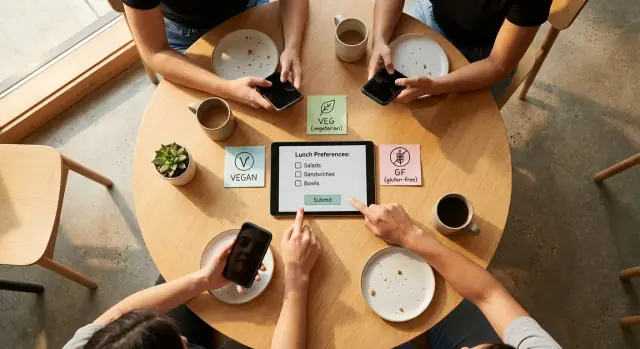
Set up a lunch preference poll to collect dietary needs fast, narrow choices, and pick a place without long group chats or confusion.
Small-group lunch plans feel like they should be easy. Then the chat starts, and ten minutes later you still don't have a place, a time, or a clear headcount.
Group chats drag on because they're built for conversation, not decisions. Messages arrive out of order, people reply to different suggestions, and one new idea resets the whole thread. Even with only four to eight people, you can end up with a pile of "I'm fine with anything" and no real signal.
A few patterns make the loop worse. People answer at different times, so the "current options" keep shifting. One strong opinion can steer the group before everyone weighs in. And many people avoid being the "difficult one" about allergies or restrictions, so important details show up late. On top of that, logistics (time, budget, location) get mixed in with restaurant opinions, and the decision gets fuzzy.
Dietary needs are the biggest hidden risk. If you discover at 11:45 that someone can't eat gluten, dairy, or meat, you either scramble to find a new place or split the group. That creates last-minute stress and can make someone feel singled out.
A simple poll helps because it turns opinions into comparable answers. Instead of trying to interpret a scrolling thread, you get one snapshot: who's in, what constraints exist, and which options have real support. It cuts down the message count and feels fair because everyone had the same chance to respond.
A poll also beats a quick "vote in chat" when the decision has more than one dimension. If you need to consider restrictions, budget, walking distance, or pickup vs dine-in, a structured poll keeps those details from getting buried. It also respects people's time: they can answer in 20 seconds without reading the whole thread.
Chat is great for suggestions. Polls are better for closing the decision.
Before you shortlist restaurants, collect a few basics. The best lunch preference polls ask only what you need to avoid a second round of back-and-forth.
Start with dietary needs and treat them as non-negotiable. Ask about allergies (especially nuts, shellfish, dairy) and common requirements like halal, kosher, gluten-free, vegan, and vegetarian. Include a simple "anything else we should know?" field so people can mention things like pregnancy-related restrictions or medication interactions without writing a paragraph.
Money matters, even for small groups. Ask for a budget range per person and whether the company is paying, someone is expensing, or everyone is paying their own bill. A $12 lunch and a $30 lunch are different decisions, and you want that clear upfront.
Location and timing are usually the next bottleneck. Collect how far people are willing to go (or a specific area), plus a time window. "Can you leave at 12:00?" is different from "anytime between 11:30 and 1:30." If it's a workday, it also helps to ask for the maximum time away from the desk.
Cuisine preferences help, but only if you separate "nice to have" from "no way." One person's craving shouldn't trap the group into a place others will resent.
To keep it quick, aim to cover these points:
Finally, confirm the format: dine-in, takeout, or delivery. A teammate on back-to-back calls might be fine with lunch, but only if it arrives at the office.
Example: for a team of six, one "gluten-free and dairy allergy" response immediately narrows the options. It's better to learn that before someone falls in love with a pizza spot.
A poll only works if people can finish it fast and trust it will lead to a decision. Start with one clear goal and a deadline: "We're picking today's lunch spot by 11:10." Without that, people treat it like a suggestion box and you end up back in the chat.
Keep your lunch preference poll short enough to complete in under a minute. Six to ten questions is plenty, and many groups only need five. Use multiple choice wherever you can so people don't have to type or explain. Save free text for the one thing that truly needs it, like "other restrictions we should know about."
Make the constraints obvious up front. If you only have 45 minutes, say so. If you can't leave the building, say so. If the budget cap is $15, put it in the question, not in a follow-up message. People answer more confidently when they know the guardrails.
A simple set of questions that gets real answers:
Separate must-haves from nice-to-haves. A must-have is a filter (someone can't eat there). A nice-to-have is a tie-breaker (someone just prefers it). If you mix them, one strong preference can look like a requirement and block good options.
Also tell people what happens after they answer: "We'll shortlist two places and do a quick final vote." When people can see the next step, they're more likely to respond quickly and less likely to reopen the debate later.
If you want this to take 15 minutes (not an hour of back-and-forth), decide two things up front: how you'll pick the winner, and when the poll closes. The rest becomes routine.
Start with a simple decision rule. For example: the top vote wins, but it must have at least one main option that works for vegetarians (or whoever is in the group). If there's a tie, you choose the cheaper or closer place. One sentence is enough. The goal is to remove debate later.
A fast workflow that works for a small group:
When you draft the questions, focus on what actually changes the restaurant choice: hard no's (nuts, shellfish, pork), budget cap (two or three ranges), distance (walk, drive, delivery), and today's cuisine mood (three to five choices). Avoid long menus of options people won't read.
Your message matters as much as the poll. Keep it direct:
Summarize results in one line: "Most votes: Thai and Mediterranean. Constraints: one gluten-free, one no shellfish. Finalists: A, B, C." Now the group can choose without reopening the whole conversation.
Dietary needs are personal, and sometimes medical. A good lunch preference poll makes it easy to share what matters without forcing anyone to explain themselves in a group chat.
Separate allergies from preferences. Allergies and medical restrictions should be treated as "must follow." Preferences (like "no onions" or "trying to eat lighter") are nice to have. If you mix them in one question, people may underreport the serious stuff to avoid being a bother.
When allergies come up, a quick follow-up about cross-contamination can prevent risky assumptions. "Nut-free" is not the same as "no peanuts in my dish." Some people need the kitchen to avoid shared surfaces, oils, or fryers.
If your group is mixed (coworkers, clients, or new teammates), consider an anonymous option. People may not want to publicly share medical details, religious rules, or health-related diets. You can still collect counts (for example: one severe allergy, two vegetarians) without naming anyone.
To keep it safe, add one line like: "If you have a severe allergy, please message me directly." It gives people a private channel for details like carrying an epinephrine auto-injector or needing a specific prep method.
A compact set of poll fields that usually works:
Plan a safe default for incomplete responses. If two people haven't answered, pick a place with clear allergen info and multiple simple options (like rice bowls or build-your-own salads) and avoid high-risk cuisines for common allergies.
Example: a team of six wants lunch. One person marks "severe peanut allergy + cross-contamination yes," two choose vegetarian, and one doesn't reply. You shortlist places where the kitchen can confirm peanut handling and where vegetarian meals are normal, then choose the option with the clearest allergen communication. That's respectful, and it keeps everyone included.
Once responses are in, the goal isn't to admire the data. It's to pick a place most people can eat at, without another round of debating.
Start by separating hard rules from preferences. Hard rules are things that make an option impossible for someone (allergies, required dietary restrictions, max budget, maximum walk or drive time). Preferences are nice to have (cuisine type, vibe, portion size).
A simple method works well: count votes, then apply constraints.
That shortlist matters because it turns "too many choices" into a quick finish. If you leave eight options, people will re-argue the entire list.
Decide how you'll handle ties before you look at results. Pick one tie-breaker and stick to it: closest to the office, cheapest average meal, fastest service, or easiest ordering for dietary needs.
Example: six coworkers vote. Two places tie with three votes each. One is a 12-minute walk, the other is three minutes away and has clear allergen info. If your tie-breaker is "closest," the three-minute option wins. If it's "diet-friendly," the clear-allergen option wins. Either way, the decision feels fair because the rule was set upfront.
Finish with one final message that ends the thread. Include only what people need:
If someone objects after that, ask them to name the specific hard rule it breaks. If it's not a hard rule, it's a preference for next time, not a reason to restart the vote.
Most lunch polls fail for the same reason: they ask for opinions that are fun to share but hard to turn into a decision. A good lunch preference poll is less about collecting everyone's dream meal and more about getting to a workable yes.
One common time sink is too many open-text questions. If five people type five different answers, you end up summarizing a mini essay instead of counting votes. Free text can be useful, but keep it optional and limited to one field like "anything we should know?"
Another trap is asking for everyone's "favorite cuisine." Favorites don't help when the real blockers are budget, distance, time, and allergies. If you don't capture constraints first, you can pick a place that looks popular but doesn't work for half the group.
Deadlines matter more than most teams expect. Without a clear close time, the poll stays "open" in people's minds, replies trickle in, and you keep waiting. A short deadline (even 20 minutes) creates momentum and makes the choice feel fair.
It also backfires to include too many restaurant options upfront. A long list makes people overthink, and it's easy to miss what they'd actually accept. Start with constraints, then propose two or three options.
Finally, don't change the plan after people respond. If you ask for votes and then pick something else, people stop answering next time. If new information appears (a place is closed), say so plainly and rerun a quick tie-break.
These are the mistakes that most often create extra rounds of messages:
Fix those and your poll becomes a simple counting exercise, not another group chat thread.
Before you send a lunch preference poll, take two minutes to make sure it can end the decision, not restart the chat.
Write the goal and the clock. People answer faster when they know what this is for and when it closes. A clear deadline also stops late replies from reopening the debate.
Collect dietary needs in a way that feels normal and safe. Don't make people explain in public. Give simple options and a short free-text box for details like "peanut allergy" or "gluten-free, no cross-contamination." If you're unsure, add a line: "If you'd rather share privately, message me."
A quick pre-send check:
Your shortlist rules matter more than people think. A simple rule like "anything that can't do vegetarian plus nut-free gets dropped" prevents awkward back-and-forth later.
A small example: if six coworkers have 35 minutes, a $15 limit, and one dairy allergy, you can set "walkable within 10 minutes" and "must clearly mark allergens." That turns ten suggestions into two realistic options.
Decide how you'll close the loop. Will you book a table, place a group order, or have everyone order individually? If you can write that in one sentence, your poll is ready to send.
A team of six needs to pick lunch for Friday. Two hard needs exist: Sam is gluten-free (medical, not a preference), and Priya is vegan. Everyone else is flexible, but nobody wants to spend 30 minutes in a group chat.
Instead of asking "Where should we go?", the organizer sends a short lunch preference poll with two parts: (1) dietary needs (check all that apply), and (2) a quick vote on a short list of four nearby options.
Within 10 minutes, all six respond. The dietary question filters out two restaurants right away: one has almost no vegan choices, and the other can't reliably handle gluten-free. That leaves two places that satisfy the hard needs:
The vote comes back tied, 3-3. Instead of restarting the debate, the organizer uses two tie-breakers everyone agreed were fair: walking time and price range. Place A is a 12-minute walk and slightly pricier. Place B is six minutes away and cheaper. Place B wins.
The final message is short, specific, and includes a backup plan in case the first choice is crowded:
Nobody had to repeat restrictions, nobody had to guess what "I'm fine with anything" means, and the group didn't get stuck cycling through new suggestions. The poll turned opinions into a decision, with a clear reason for the tie-break and a fallback that avoided another round of messages.
The fastest lunch decisions happen when you treat them like a small routine, not a fresh debate every time. Once you have a poll that works, keep it and reuse it with tiny tweaks (date, budget, location).
Save a simple template. A good default stays useful for months: dietary needs, budget range, distance or delivery, and a short list of options. When someone new joins, you add one line instead of restarting the whole process.
It also helps to keep a small approved list of places that reliably cover common needs (vegetarian, vegan, gluten-free, halal, nut-free). Keep it short and trusted, not "every restaurant nearby." Aim for places your group has tested and liked, with at least one safe fallback.
A repeatable setup for most small teams:
If your group does this often, a tiny internal tool can be faster than rebuilding a form every time. For example, a simple "Lunch Picker" page can store preferences, filter places that match, and generate a summary like "4 want budget, 2 need gluten-free."
Some teams build small apps like this in Koder.ai (koder.ai) by describing the poll in a chat prompt and asking for an automatic summary. If you decide to keep it long-term, you can export the source code or deploy and host it so the same workflow is ready for the next lunch run.
For your next run, try two small upgrades: automatic summaries (so nobody has to count votes) and a decision deadline that's visible in the poll. A simple rule like "no vote by the deadline means you're flexible" removes pressure and keeps lunch moving. " }
Use a poll when you need a decision, not more conversation. A poll turns “I’m fine with anything” into clear inputs like who’s in, what the limits are, and which options actually have support.
Collect dietary restrictions and allergies first, then budget, distance, and time window. Add cuisine as a “nice to have,” not a requirement, so preferences don’t override safety or logistics.
Set a clear deadline and keep it short enough to finish in under a minute. People respond faster when they know exactly when it closes and what will happen after they submit.
Treat allergies and medical restrictions as non-negotiable, and separate them from preferences. Include a way for someone to message you privately for details like cross-contamination risk.
Default to a safe, inclusive option with clear allergen information and multiple simple choices. Also state upfront that no response means the person is okay with the final shortlist, so you’re not stuck waiting.
Pick the tie-breaker before you see results, then apply it consistently. Common tie-breakers are closest, cheapest, fastest service, or easiest to order safely for dietary needs.
Too many options makes people overthink and re-argue. Start by collecting constraints, then propose two or three finalists that already fit the group’s must-haves.
Avoid multiple open-text questions because they create summaries you have to interpret. Also don’t ask for favorites before constraints, and don’t change the decision rule after people respond or they’ll stop participating next time.
Send one final message with the chosen place, the exact time, and how ordering will work. If someone objects, ask whether it breaks a stated hard rule; if not, treat it as feedback for next time instead of restarting the vote.
If your team does this often, a small internal “Lunch Picker” can save time by storing constraints, generating shortlists, and summarizing votes automatically. You can build a simple version in Koder.ai by describing the poll flow and the summary you want, then reuse it each week.