

May 31, 2025·8 min
Stripe’s Moat: APIs, Compliance, and Global Expansion
How Stripe built a defensible payments platform: developer-first APIs, compliance as infrastructure, and global expansion that turns payments into sticky products.
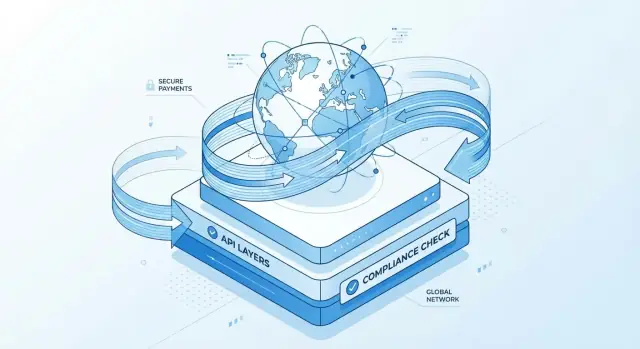
How Stripe built a defensible payments platform: developer-first APIs, compliance as infrastructure, and global expansion that turns payments into sticky products.
Payments look simple from the outside: a customer taps “Pay,” money moves, and the business gets paid. But for companies building on top of payments—SaaS products, marketplaces, subscription apps—the real question isn’t “Can we process cards?” It’s:
That’s where a payments “moat” matters. In practical terms, a moat is what keeps a payments provider from being interchangeable. It’s the combination of:
This article uses Stripe as the case study—not to retell company history, but to understand the strategic themes behind its growth. You’ll see how three levers—APIs, compliance, and global expansion—help turn payments from a commodity into a platform.
The point isn’t to memorize product names. It’s to see the pattern: make developers productive, absorb regulatory complexity, and support local payment methods in a way that compounds over time.
John Collison, Stripe’s co-founder and president, is often described as the operator who helped turn an elegant idea into a scalable business. Stripe is known for developer-friendly payments, but it also had to become excellent at partnerships, product execution, and the unglamorous details of financial infrastructure.
Collison’s role has consistently centered on building the organization and systems that let Stripe expand without losing the simplicity that made it attractive in the first place.
Stripe’s early focus was straightforward: help internet businesses accept payments with less friction. For many online teams, payments weren’t the “product”—they were a necessary dependency. Stripe aimed to make that dependency easy to set up, predictable to run, and flexible enough to fit different business models.
That emphasis mattered because payments touch everything: checkout conversion, customer trust, support workload, and cash flow. Making payments easier wasn’t only a technical improvement; it removed a bottleneck that slowed down growth.
The bet behind Stripe’s moat was to earn developer trust first—by making integration feel like building software, not negotiating with a bank. Once developers chose Stripe for a narrow, high-value use case (take payments), Stripe could expand the “surface area” around that core: more payment methods, more countries, and more tools for operations and finance.
This sequencing is how a product becomes a platform. When the same team relies on one provider across billing, fraud controls, reporting, and payouts, the relationship becomes deeper than a single feature—and much harder to replace.
Stripe’s early wedge wasn’t a new payment method—it was a simpler way to integrate payments.
Before unified APIs, many businesses stitched together a legacy stack: a payment gateway, a separate merchant account, a fraud tool, a tokenization provider, and a reporting portal—each with its own contract, credentials, and failure modes.
A unified API approach compresses that sprawl into one integration surface. Instead of negotiating five vendors and maintaining five SDKs, teams can build a single payments layer that handles core flows (charge, refund, store payment details, reconcile) with consistent objects and predictable behavior.
Developer experience (DX) becomes distribution. If the first integration is fast and pleasant, product teams ship payments earlier, then expand usage over time—adding subscriptions, invoicing, marketplaces, or international methods without restarting from scratch.
Stripe leaned into DX as a product: clear docs, copy‑pasteable examples, and tooling that reduces “integration tax.” That matters because payments code tends to be business-critical and hard to revisit once it’s live.
Payments APIs aren’t “nice to have.” They’re expected to behave like infrastructure:
This API layer translates directly into speed: launch billing sooner, test pricing sooner, and learn from real transactions sooner.
More importantly, a clean API reduces operational drag later—fewer midnight incidents, fewer “mystery declines,” and less custom glue code when you expand to new products or geographies. That compounding reduction in effort is how an API becomes a moat.
If you’re building a SaaS or marketplace around a payments provider, the bottleneck often isn’t the payment API itself—it’s everything adjacent: checkout UI, subscription state, webhooks, admin dashboards, reconciliation exports, and support tooling.
Koder.ai can be useful here as a vibe-coding platform for rapidly generating the surrounding application from chat—web (React), backend services (Go + PostgreSQL), and even a companion mobile app (Flutter). Teams can iterate safely with planning mode, use snapshots and rollback during risky changes, and export source code when they want full control of the codebase.
A “platform” in payments isn’t just a bundle of features. It’s the idea that a business does one core integration, then can turn on many capabilities as it grows—without re-architecting checkout every time it hits a new stage.
The starting point is simple: accept payments. But once that connection exists, the same underlying rails can support adjacent needs—subscriptions, invoices, taxes, fraud prevention, reporting, and payouts.
The practical benefit is speed: adding a new revenue model or entering a new market feels like an extension of what’s already working, not a new vendor search.
Payments touches finance, operations, support, and engineering. When a company also uses billing for subscriptions, fraud tooling to manage chargebacks, and unified reporting to reconcile payouts, teams start to rely on shared workflows and consistent data.
That dependency isn’t “lock-in” for its own sake—it’s operational continuity. Replacing one component often means re-testing many flows (checkout, refunds, disputes, reconciliation), retraining teams, and repeating compliance reviews.
Cross-sell is usually trigger-driven. A business might add billing after launching a subscription tier, adopt fraud tools after an attack spike, or upgrade reporting when finance needs cleaner month-end closes. The platform’s job is to make these add-ons easy to evaluate, pilot, and deploy.
As more payments run through a single system, the ecosystem can get smarter: better risk signals, clearer analytics, and smoother operations. Usage growth doesn’t only increase revenue—it can improve the product experience, reinforcing why platforms compound while one-off processors often stall.
Payments aren’t just about moving money; they’re about proving—continuously—that the right people are moving the right money for legitimate reasons.
For Stripe, compliance isn’t a one-time hurdle before launch. It’s a permanent trust layer that makes the product usable for more businesses, in more places, with fewer surprises.
A modern payments platform has to handle multiple “proof” systems at once:
When this is built into the platform, merchants don’t need to stitch together separate vendors, legal advice, and manual review processes just to accept payments safely.
Well-designed compliance systems lower the chance of account freezes, delayed payouts, and sudden “we need more documents” moments at the worst possible time (like during a launch). For marketplaces, it also reduces the risk of onboarding bad actors who can trigger downstream problems—chargebacks, fraud investigations, or regulatory scrutiny that affects the entire platform.
Compliance investment tends to favor scaled providers: they can afford specialized teams, build repeatable verification workflows, and maintain relationships with banking partners and regulators.
But requirements vary by country, payment method, and business model. Even the best platform can’t “standardize away” local rules—compliance must be continuously adapted.
Payments don’t fail only because a card is expired. They fail because banks see suspicious patterns, customers forget purchases, or fraudsters probe checkout flows at scale.
A payments platform’s moat is often built in this unglamorous layer: preventing bad transactions while keeping good ones flowing.
Every false decline is lost revenue and a frustrated customer. Risk systems try to separate “likely fraud” from “legit but unusual” behavior fast enough to approve the right payments.
This typically involves risk scoring—evaluating signals like device data, velocity (how often attempts occur), mismatch patterns, and historical behavior—so merchants can block, review, or allow transactions with confidence.
Better fraud controls can even increase approval rates because issuers are more comfortable approving transactions that resemble known-good activity, and because merchants reduce noisy patterns that trigger bank skepticism.
Even legitimate payments can turn into chargebacks when customers don’t recognize a descriptor, don’t receive goods on time, or hit “refund” in their bank app instead of contacting support.
The dispute workflow is its own mini back office:
When this work is built into the platform, merchants avoid stitching together spreadsheets, email threads, and processor portals just to keep loss rates under control.
In regions like Europe, Strong Customer Authentication (SCA) can require extra verification. 3D Secure (3DS) helps satisfy these rules, but the challenge is applying it only when needed—adding friction to risky transactions, not to every checkout.
A platform can learn from patterns across many businesses (attack spikes, emerging fraud tactics, dispute behaviors) and feed those learnings back into risk models and recommended controls.
Outcomes still vary. Industry, ticket size, fulfillment model, and geography change the playbook—and the best systems make that variability manageable rather than surprising.
“Global payments” sounds like a feature you toggle on. In practice, it’s a long series of local problems that don’t generalize: each country has its own preferred payment methods, bank rails, currency rules, consumer protections, and regulatory expectations.
Customers in one market might default to cards; in another, bank transfers, wallets, or cash-based vouchers dominate. Even when the method name is the same, the underlying flow can differ (authentication, refunds, chargeback rights, settlement timelines).
Add currency conversion, cross-border fees, and local data requirements, and “accept payments worldwide” becomes a careful engineering and compliance project.
Expanding to a new country usually means stacking multiple workstreams:
None of this is one-and-done. Regulations evolve, banks update requirements, and payment schemes change dispute rules—so the “global” layer becomes ongoing infrastructure.
For merchants, the payoff is operational simplicity. Instead of stitching together different providers per region, a single platform can handle acceptance and settlement across markets, reducing finance overhead and simplifying reconciliation.
Consistent reporting and standardized webhooks also make it easier to manage refunds, disputes, and payouts across geographies.
Launching in a new market often requires local languages in checkout flows, region-specific tax handling, and clear expectations around settlement timing (which can vary by method and country). When those details are handled well, “global expansion” feels seamless to end users—while staying compliant behind the scenes.
Marketplaces don’t just “take payments.” They sit in the middle of transactions between buyers and sellers, which turns a simple checkout into a web of onboarding, payouts, tax and identity requirements, and ongoing monitoring.
The moment a platform enables other people to earn money, payments becomes part of the product—not a bolt-on.
A direct-to-consumer business can often treat payments as a single flow: customer pays, merchant receives funds. Marketplaces add more moving parts:
To work smoothly, platforms typically require capabilities aligned to multi-party money movement:
When these pieces are baked into a payments platform, the marketplace can focus on its core experience—search, matching, fulfillment, trust—without building a mini bank internally.
Once payouts, reporting, and dispute handling are embedded into everyday workflows, switching processors isn’t just “change the checkout button.” It touches seller onboarding, finance ops, support processes, and compliance routines. That operational dependency is where platforms get sticky.
Ask:
If “yes” shows up often, you’re in marketplace territory—and should choose payments infrastructure designed for it.
Switching payment providers sounds simple—“just route transactions somewhere else.” In reality, once payments are woven into your business, the costs of change are less about code and more about reliability, pricing, and day-to-day operations.
When a processor is down, you don’t just lose revenue—you create customer support tickets, break subscriptions, trigger fraud rules, and disrupt fulfillment.
Over time, teams build internal playbooks around a provider’s behavior: retry logic, error handling, fallback payment methods, and reporting cadences.
Operationally, mature payment setups depend on:
Once those workflows are stable, switching introduces risk: new edge cases, different settlement timing, and new failure modes.
Processing fees matter, but so do the “hidden” economics: authorization uplift, dispute costs, cross-border FX margins, payout fees, and the engineering time needed to maintain integrations.
A slightly cheaper rate can be offset by lower approval rates or more manual ops.
Larger companies can’t swap providers on a whim. Expect vendor risk assessments, security reviews, compliance questionnaires, and finance sign-off.
Ironically, the more trustworthy a provider is, the harder it is to justify switching internally: “What problem are we solving—and what new risks are we adding?”
Design for optionality early:
If you ever need to dual-run providers, plan for parallel reporting and a staged rollout by geography or payment method.
Stripe’s growth story isn’t only about payments capability—it’s also about how quickly developers can successfully ship. When integration feels predictable and pleasant, the product markets itself: every prototype, proof-of-concept, and feature rollout becomes a distribution channel.
Clear docs act like a product surface, not an appendix. Well-structured quickstarts, copy‑paste examples, and “what happens next” explanations help teams move from curiosity to a working checkout quickly.
SDKs amplify that effect. When official libraries feel native in each language, developers spend less time translating concepts and more time building business logic.
Sample apps matter too: a runnable checkout demo, a subscription example, or a marketplace flow can serve as a reference architecture—especially for smaller teams without dedicated payments expertise.
Developer-first distribution thrives on self-serve loops:
Ecosystems turn individual adoption into broad reach. Integration partners (ecommerce platforms, invoicing tools, agencies, systems integrators) package payments into “ready-made” solutions. Community tutorials and open-source examples help answer the question every builder has: “Has someone already solved my exact use case?”
A payments moat isn’t a story you tell—it’s a set of metrics that show customers stick, volumes grow, and operations get easier over time.
The trick is measuring the right things: not just GMV, but the hidden drivers of trust and switching costs.
Start with a small dashboard that connects adoption → performance → retention:
Moats widen when customers consolidate. Track attach rate (what % adopt a second product), product mix over time, and share of wallet (what portion of a customer’s total payment volume you process).
Adding billing, fraud tooling, invoicing, payouts, or local payment methods can raise retention because workflows become integrated—switching becomes an operational project, not a vendor swap.
Enterprises buy “fewer surprises.” Monitor:
When these are strong, sales cycles shorten and larger accounts become feasible.
Stripe’s moat isn’t a single feature—it’s a set of compounding advantages that make payments feel “done” rather than “assembled.” Across Stripe’s story, three pillars show up again and again: APIs, compliance, and global expansion.
1) APIs (the wedge): Developer-first APIs reduce the time and risk of building payments. When integration is simple, teams ship faster, iterate more, and standardize on the same provider across products.
2) Compliance (infrastructure, not paperwork): Payments include identity checks, data security, reporting, and constantly changing rules. When a provider turns compliance into built-in infrastructure, companies avoid creating a second “shadow product” just to stay operational.
3) Global expansion (scale without fragmentation): Real growth means supporting local payment methods, currencies, tax and regulatory requirements, and settlement preferences. A unified platform that handles global complexity prevents teams from running a different stack per country.
A true payments platform reduces work across the full lifecycle: integration, onboarding, authorization rates, fraud, dispute handling, reporting, and international rollout.
The more of that lifecycle your provider absorbs, the more payments turns into an operating system for revenue—not a checkout button.
Ask these questions before you choose (or re-evaluate) a provider:
Map your required countries, payment methods, and operational workflows, then validate pricing and support models on /pricing.
If you’re trying to ship the application layer around payments faster—dashboards, webhook-driven back office flows, subscription management, and internal tooling—Koder.ai can help teams go from requirements to a working React + Go + PostgreSQL stack via chat, with source-code export and deploy/hosting options when you’re ready to productionize.
A payments “moat” is the set of advantages that make a provider hard to replace in practice. It usually comes from:
The real risk isn’t whether you can run a card charge—it’s whether payments stay reliable, compliant, and economically viable as you scale. Breakdowns show up as:
APIs reduce “integration tax” and make payments feel like software, not banking procurement. Look for infrastructure-grade API traits:
Stripe’s early strategy was to win developers with a fast, predictable integration, then expand into adjacent workflows (billing, fraud, payouts, reporting, tax). That sequencing matters because once multiple teams depend on the same data and tools, replacement requires reworking more than checkout.
A platform becomes “sticky” when the surrounding workflows are integrated. Common adoption triggers include:
The key is that add-ons are easy to pilot without re-architecting payments.
Compliance is ongoing infrastructure that keeps money movement legitimate and sustainable. Built-in compliance commonly covers:
Good compliance reduces surprises like freezes and payout delays.
They’re operational workflows, not edge cases. Practical steps to manage them:
If your provider centralizes dispute tooling, it can reduce manual back-office work.
SCA requirements can add friction, but you don’t want to challenge every buyer. A practical approach is:
The goal is meeting regulatory rules while keeping checkout smooth for low-risk customers.
“Global” means local payment methods, settlement rails, regulatory obligations, and consumer protection rules that don’t generalize well. Expanding usually requires:
A unified platform helps you avoid running a different stack per country.
The biggest switching costs are operational and financial, not just code. Before migrating, plan for:
To reduce future pain, keep payments behind an internal abstraction and document workflows; validate terms and economics on /pricing and integration expectations on /docs.