

Dec 20, 2025·8 min
How EA’s Live Ops and Monetization Prove Games Are Services
How Electronic Arts moved from boxed releases to always-updated services—using monetization design, live ops, and franchise ecosystems to drive retention.
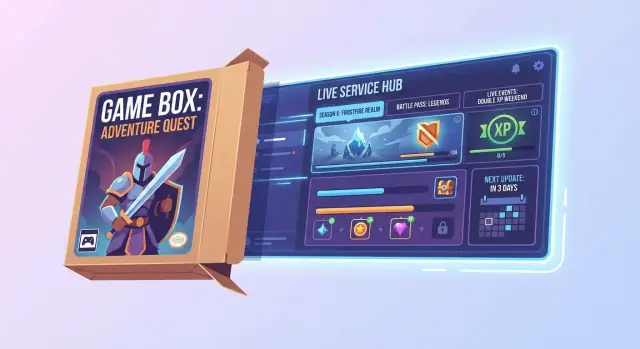
How Electronic Arts moved from boxed releases to always-updated services—using monetization design, live ops, and franchise ecosystems to drive retention.
A boxed product game is built around a single moment: launch day. You pay once (disc or download), play what ships, and maybe buy an expansion later. Success is measured mostly by units sold in a tight release window.
A perpetual service game is built around continuity: the game keeps changing after launch through updates, events, new modes, and new items. You might still pay an upfront price, but the business depends on ongoing engagement and ongoing spending over months or years.
The goal moved from “sell a copy” to “keep a relationship.” That changes what gets designed, what gets shipped, and how teams judge whether something is working.
EA has long-running franchises across different audiences—sports (EA SPORTS FC, Madden), shooters (Apex Legends, Battlefield), and life sims (The Sims). Because these series span the pre-digital era through today’s always-updated releases, you can see the service mindset evolve in real time: recurring content, recurring monetization, and recurring operations.
This isn’t an insider account or a claim about secret plans. It’s a pattern-based look at how large publishers tend to run services—and how EA’s portfolio makes those patterns easier to spot.
First, monetization design: what players can buy, how pricing is framed, and how purchases connect to progression.
Second, live ops: the ongoing work of running a game—content calendars, fixes, events, and responding to player behavior.
Third, franchises: how a “game” becomes a platform that can support multiple modes, communities, and revenue streams over time.
Before games behaved like ongoing services, most big titles were built around a simple arc: ship, market hard, and then move on. The team would spend years building a “gold master,” press discs, send them to stores, and aim for a strong launch window. If the game hit, the follow-up plan was usually a sequel or an expansion—on a new disc, with a new marketing beat.
That classic model shaped design decisions more than people remember. Because the product had to feel “complete” on day one, publishers optimized for:
If something wasn’t finished, it often didn’t ship—because after release, getting fixes to players wasn’t guaranteed.
Physical retail created hard constraints. Manufacturing and shipping took time, which meant release dates were real deadlines, not flexible targets. Games also competed for limited shelf space, so publishers fought for prime weeks (holiday, summer, major sports seasons). That pressure encouraged “event” launches and sequels you could sell as a fresh box.
The boxed model had built-in weaknesses:
Once downloads, patches, and online accounts became standard, the center of gravity shifted. Updating a game after launch became normal, and keeping players engaged month after month started to matter as much as the launch spike—setting the stage for service-style design.
Publishers didn’t move to “services” only to sell more. They moved because the goals of modern game-making changed: keep players engaged longer, make spending more predictable over time, and reduce churn between launches. A hit game is no longer judged only by launch week—it’s judged by whether it can hold attention month after month.
Players increasingly expect games to be alive. Online matchmaking, always-on social features, and cross-platform play create communities that don’t want to reset every year. Streaming and creator culture also reward games that provide a steady flow of new moments—fresh modes, limited-time events, seasonal rewards—so there’s always something worth watching (and jumping back into).
Budgets grew while audience expectations grew even faster. Big games now need longer development cycles, more content, and more post-launch support. At the same time, digital distribution made it easier to update frequently and to sell content in smaller pieces, instead of relying on a single boxed release to “pay for everything.”
Services also change financial planning. Instead of betting the year on one launch window, publishers can smooth revenue through recurring spending: expansions, cosmetic stores, subscriptions, and event-based offers. That steadier cadence helps fund ongoing development, customer support, and anti-cheat—things players demand but a one-and-done product model struggled to justify.
A service game can include both free and paid updates. Free drops (balance patches, new maps, quality-of-life improvements) keep the community healthy; paid content can fund that work—when it’s designed in a way players feel is fair.
A boxed game is usually a single transaction: you pay once, you get the full package. A service model flips the question from “What’s in the box?” to “What will players do over the next 12 months?” Monetization stops being a checkout screen and becomes part of how the game is paced, rewarded, and updated.
Most ongoing games mix a few familiar options:
What’s new in services is the continuous layering: pricing and offers are planned alongside content drops, events, and seasonal beats.
“Pay for content” usually means you buy more game: a new expansion, a new character pack, a new mode.
“Pay for progression/advantages” is different: you pay to reach goals faster (leveling, unlocking, upgrading) or to improve competitive strength. EA examples vary by franchise—some lean on cosmetic and pass-style value, while others build deeper economies where currency, packs, and upgrades accelerate progression.
Reward design nudges behavior. A battle pass can encourage regular weekly sessions; a limited-time store can make players check in more often; discounted bundles can shift spending toward fewer, bigger purchases. None of this is automatically “good” or “bad”—it’s simply how incentives work.
Service monetization works best when it’s clear what players buy (access, cosmetics, currency), what they earn (playtime rewards), and why an item is priced the way it is (time saved, rarity, season timing). Clear labels, odds disclosure where relevant, and predictable reward tracks help players make informed choices—and reduce trust issues later.
A key difference between a boxed release and a service is how spending is paced. Instead of paying once, players are invited into small, repeatable purchase moments—often tied to time-limited content, upgrades, or collection goals.
Card packs (and other loot-style bundles) are built around a simple loop: open a pack, see what you got, then decide whether to try again to chase a specific player/item or a better version. In modes like Ultimate Team-style systems, this is amplified by constant roster updates, events, and new “best-in-slot” items that reset what feels desirable.
The psychological driver isn’t just ownership—it’s variance. When results are luck-based, a good pull can justify “one more,” while a bad pull can trigger “I’m due.” That’s why these systems can generate recurring spending more reliably than straightforward DLC.
Service games often use layered currencies (coins, points, tokens) so pricing feels consistent even as the economy evolves. Designers then manage the game like an economy:
If sinks are too weak, inflation makes everything trivial. If sinks are too strong, players feel squeezed and progress stalls—pushing them toward paid currency.
The same loops that drive revenue can damage trust. Common pitfalls include pay-to-win perceptions, grind pressure that nudges purchases, and luck-based outcomes that feel exploitative—especially when competitive advantage is at stake.
Where required (and increasingly expected), clear odds disclosures matter. Rules vary by region, so publishers often tailor pack odds, disclosures, and even availability to local regulations and platform policies.
Live ops (live operations) is the day-to-day practice of keeping a game feeling current after launch. Instead of shipping one “final” version, teams run seasonal updates, timed events, store rotations, and limited-time modes that refresh goals and keep matchmaking populated.
Most service games follow a loop that looks predictable on purpose:
Live ops is driven by telemetry: retention (who comes back), matchmaking health (queue times, skill spread), and content performance (which modes are played, where players drop off, what items are used). This data isn’t only about revenue—it keeps the game playable by ensuring enough players are in the right places at the right times.
Running a perpetual game means constant operations: moderation for toxicity and UGC, anti-cheat updates and enforcement, and customer support for missing items, bans, refunds, and account issues. These functions quietly determine whether players trust the service—and whether they’ll show up for the next season.
A service game survives on repeatable engagement, and that starts with the difference between the core loop and the meta loop.
The core loop is what you do minute-to-minute: play a match, complete a mission, build a house, win/lose, get a reward. It’s the “is this fun right now?” layer.
The meta loop is what keeps you returning over weeks: progression levels, collections, challenges, cosmetics, ranked ladders, and long-term goals. EA service-style titles often use meta systems (like collecting players, improving squads, or expanding a catalog of items) to give every session a purpose beyond the immediate win.
A battle pass is basically a seasonal reward track with a deadline. Most versions share a few rules:
Done well, the pass feels like a clear menu of goals. Done poorly, it feels like a job.
Seasons reset attention. They create a natural “jump-in moment” with a theme, patch notes, a new pass, and headline features—making marketing simpler than promoting a constant drip of changes. Internally, seasons also help teams plan content in predictable cycles.
Seasonal systems can create stress: fear of missing out, repetitive grinding, and “I paid, so I must finish.” Healthier designs reduce burnout by offering choice (multiple ways to earn progress), catch-up mechanics, and reasonable pacing (weekly goals that can be stacked, not daily chores). When the meta loop respects players’ time, seasons feel energizing rather than exhausting.
A recognizable franchise isn’t just a marketing asset—it’s a service platform. When players already understand the rules, tone, and promise of a series, the publisher spends less to persuade them to try (lower acquisition costs), and players take less risk by returning. That familiarity also builds trust: people may not love every change, but they know roughly what they’re buying into.
Long-running series can reuse technology and design “plumbing” across releases and spin-offs: account identity, progression frameworks, matchmaking, storefront flows, telemetry, and content pipelines. Once these systems exist, each new entry can launch with the service layer already in place, then improve it rather than reinvent it.
This reuse isn’t only about saving money. It’s what makes ongoing updates practical: new modes, limited-time events, cosmetic catalogs, and tuning changes can be delivered with fewer delays because the tools and teams already know the engine.
A yearly (or regular) launch can act like a major “season reset”: new core gameplay, refreshed rosters or features, and a marketing moment. The service layer runs alongside it—continuing challenges, live events, and in-game economies that keep players engaged between big beats.
Franchise services must evolve, but not too sharply. Big changes risk breaking player habits and community identity; too little change feels like a reskin. The trick is choosing where to innovate (new modes, social features, onboarding) while keeping the franchise’s most valued loops steady.
EA’s shift to services shows up differently depending on the genre, but the pattern is consistent: the “game” becomes a platform that supports ongoing play, spending, and updates rather than a one-time finish line.
In EA Sports-style modes, the service model is built around a long-term team or roster you actively grow. You’re not just playing matches—you’re managing a collection that can be upgraded over time.
That persistence changes the design priorities. Progression is framed as a season-long journey: earn rewards, improve your lineup, and respond to new content drops (special players, themed challenges, limited-time objectives). Live updates keep the meta moving so the “best” approach doesn’t stay solved for long.
A free-to-play shooter service usually centers on cosmetic identity and social momentum. Instead of selling power, the game sells expression: character looks, weapon skins, emotes, and themed bundles.
Seasons provide structure: a fresh reward track, rotating modes, and a reason to return weekly. Limited-time events do the heavy lifting for excitement—new challenges, collaboration-themed items, and temporary rule twists that make the game feel different without rebuilding the core.
Life sims often run as evergreen sandboxes, where players invest in their worlds for years. The service pattern here is steady expansion: new activities, locations, objects, and systems that layer onto an existing save.
Just as important is community: creators, mods, and shared builds turn content into a loop that players feed back into. The publisher supports that loop with curated drops, creator-friendly tools, and updates that keep old saves compatible while still feeling fresh.
Across all three, the product isn’t just shipped—it’s operated.
Running a game as a service means treating every update like a mini product launch—measured, adjusted, and measured again. Publishers like EA watch a small set of KPIs (key performance indicators) because they explain, in plain terms, whether players are having a good time and sticking around.
Metrics are tied to practical knobs: reward pacing, challenge difficulty, event timing, and price points. If retention falls mid-season, designers may add a catch-up mechanic, tune XP, or schedule a limited-time event when players typically drift away.
A/B tests show two versions of something (like bundle pricing or a login reward) to see which performs better. Done well, it reduces guesswork and can improve clarity and fairness. Done poorly, it becomes a spending optimization engine.
Ethical guardrails matter: avoid dark patterns, limit “fear of missing out” pressure, keep odds and pricing transparent, and add protections for younger or vulnerable players (spend caps, cooldowns, strong parental controls).
Service-style games ask players for something beyond the purchase: ongoing time, attention, and often recurring spend. That makes trust a core system—every update, price change, or event is interpreted through “are they treating me fairly?” EA has seen both sides of this: loyal communities that accept long-term monetization, and flashpoints when changes feel sudden or extractive.
Trust tends to grow when four basics are consistently met: clarity (players understand what they’re buying), fairness (spend doesn’t invalidate skill or time), stability (updates don’t constantly break the game), and communication (changes are explained before they arrive).
Backlash usually happens when one of those breaks—especially:
At a high level, regulators and platforms focus on areas like loot box scrutiny, age ratings, and clear disclosures (especially around randomized rewards and odds). Even when rules vary by country, the direction is consistent: more transparency, stronger protections for younger players, and less tolerance for confusing purchase flows.
Teams running perpetual games often earn goodwill through simple habits: publish a lightweight roadmap, write readable patch notes, and offer compensation when issues affect progress or paid items. Keep support channels visible (in-game and on the web), and be explicit about what changes over a season versus what stays stable—players can accept monetization better when the rules feel predictable.
A perpetual game isn’t “finished” at launch—it’s operated. That changes how a studio is built, scheduled, and measured. Instead of a single production team sprinting toward release and then dispersing, you need a stable live organization that can ship updates, respond to incidents, and keep quality steady month after month.
Live ops works best when design, engineering, art, QA, and publishing functions sit in one loop. Teams plan seasons, tune economies, and ship hotfixes together, because a small change to rewards or matchmaking can ripple into retention and revenue.
You also need operational coverage: incident response, server monitoring, and clear escalation paths. On-call rotations aren’t just for backend engineers—release managers, QA leads, and sometimes economy designers may be involved when a bug affects progression or purchases.
Service games depend on predictable content drops, which pushes studios toward modular content and stronger tooling: templates for events, configurable challenges, reusable cosmetics, and build systems that reduce manual steps.
Approvals get faster too. Legal, brand, platform compliance, and monetization reviews can’t be end-of-project gates anymore; they become lightweight checkpoints embedded in the pipeline.
In practice, studios also end up building a lot of internal software to run the service—admin panels, event configuration tools, support consoles, KPI dashboards, and incident runbooks. Teams increasingly use rapid app-building approaches to avoid spending a full sprint on “just tooling.” For example, a vibe-coding platform like Koder.ai can help teams spin up internal web tools (often React on the front end, Go + PostgreSQL on the back end) from a chat-driven spec, then iterate quickly as live ops requirements change.
Community management becomes a frontline discipline, not a marketing add-on—triaging issues, setting expectations, and feeding sentiment back into priorities. Data analysts and experiment owners help evaluate tuning changes. Security and anti-cheat teams are ongoing necessities, especially when economies and competitive modes are at stake.
Running a perpetual game is a long commitment. Live obligations can pull senior talent away from new projects, and roadmaps can harden around “keep the service healthy” work, limiting creative resets that boxed releases used to allow.
EA’s shift makes one point clear: a “service game” isn’t one feature—it’s a system built on three levers that reinforce each other.
Monetization design is the economic engine: what players can buy, how pricing feels, and how value is delivered over time.
Live ops is the operating rhythm: the cadence of updates, fixes, events, and communication that keeps the game feeling current.
Franchise ecosystem is the multiplier: shared accounts, modes, and communities that make each release feed the next rather than reset from zero.
Do start with trust-building basics: clear patch notes, stable servers, fair pricing, and support that answers real issues.
Do design purchases around convenience or cosmetics before you touch power or progression.
Don’t add three currencies, limited-time pressure, and loot-style randomness all at once—complexity amplifies backlash.
Don’t treat content like a treadmill; repetition without meaningful change trains players to churn.
Start with post-launch updates (bug fixes + a small content drop).
Move to time-boxed events (a theme, a challenge, a reward) to learn cadence and operations.
Only then consider deeper economies (currencies, sinks, marketplaces, long-term progression), because they demand ongoing balancing and player-facing clarity.
If you do need custom tools along the way—an event scheduler, a simple live-ops CMS, or a support-facing console—building and iterating them quickly (rather than perfectly) is often the difference between “we can run seasons” and “we’re stuck firefighting.”
Expect more hybrid models (premium + optional service layers), wider cross-progression, and stronger creator tooling that turns communities into content engines—raising the bar for both quality and accountability.
A boxed product is built around a one-time purchase and a launch window where success is mostly measured in units sold. A perpetual service is built around ongoing updates and ongoing engagement, where success depends on retention and recurring spend over months or years.
Because EA operates multiple long-running franchises across sports, shooters, and life sims, you can see the same service principles applied in different ways:
That variety makes the underlying “service playbook” easier to spot.
A service mindset changes the design target from “complete on day one” to “worth coming back to.” In practice that often means:
It doesn’t automatically mean worse design—but it does change priorities.
Common service monetization building blocks include:
Most service games mix these and coordinate them with seasons and events rather than treating monetization as a one-time checkout.
“Pay for content” buys more game (expansions, characters, modes). “Pay for progression/advantage” buys faster or stronger outcomes (accelerated leveling, upgrades, competitive strength).
If you’re evaluating fairness, ask:
They create repeatable purchase moments by combining:
This can fund ongoing development, but it also raises fairness and transparency concerns—especially when randomness affects competitive outcomes.
Live ops is the continuous work of running a game after launch so it feels current and playable. It usually includes:
In short: the game isn’t “done” at launch—it’s operated.
Telemetry is the data that shows what players are doing and where friction appears. Teams use it to tune things like:
Used well, it improves playability and pacing—not just revenue—because it helps keep players in the right places at the right times.
A battle pass is a seasonal reward track with a deadline. It typically has:
To avoid burnout, look for designs with (multiple ways to earn XP), , and weekly goals that don’t require daily play.
Trust usually improves when the game delivers consistent clarity, fairness, stability, and communication. Practical trust-builders include:
Backlash often follows surprises (unannounced changes), pay-to-win perceptions, or unstable updates.