

Jan 05, 2026·6 min
Debug bug reports you didn’t write: a practical workflow
Debug bug reports you didn’t write with a practical workflow to reproduce issues, isolate UI/API/DB, and request a minimal, testable AI fix.
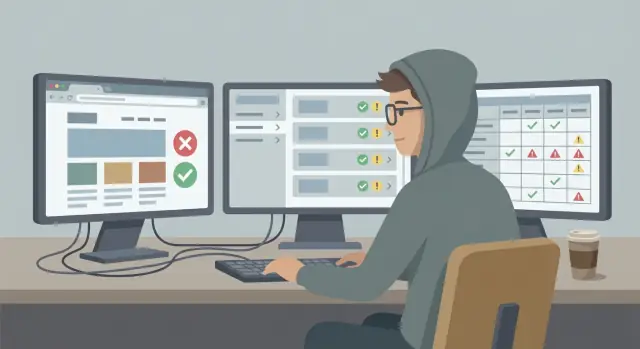
Debug bug reports you didn’t write with a practical workflow to reproduce issues, isolate UI/API/DB, and request a minimal, testable AI fix.
Debugging a bug report you didn't write is harder because you're missing the original builder's mental map. You don't know what's fragile, what's "normal," or which shortcuts were taken. A small symptom (a button, a typo, a slow screen) can still come from a deeper issue in the API, database, or a background job.
A useful bug report gives you four things:
Most reports only give the last one: "Saving doesn't work," "it's broken," "random error." What's missing is the context that makes it repeatable: user role, the specific record, the environment (prod vs staging), and whether it started after a change.
The goal is to turn a vague symptom into a reliable reproduction. Once you can make it happen on demand, it's no longer mysterious. It's a series of checks.
What you can control right away:
"Done" isn't "I think I fixed it." Done is: your reproduction steps pass after a small change, and you quickly retest nearby behavior you might've affected.
The fastest way to lose time is changing multiple things at once. Freeze your starting point so each test result means something.
Pick one environment and stick to it until you can reproduce the issue. If the report came from production, confirm it there first. If that's risky, use staging. Local is fine if you can closely match the data and settings.
Then pin down what code is actually running: version, build date, and any feature flags or config that affect the flow. Small differences (disabled integrations, different API base URL, missing background jobs) can turn a real bug into a ghost.
Create a clean, repeatable test setup. Use a fresh account and known data. If you can, reset the state before each attempt (log out, clear cache, start from the same record).
Write down assumptions as you go. This isn't busywork; it stops you from arguing with yourself later.
A baseline note template:
If reproduction fails, these notes tell you what to vary next, one knob at a time.
The quickest win is turning a vague complaint into something you can run like a script.
Start by rewriting the report as a short user story: who is doing what, where, and what they expected. Then add the observed result.
Example rewrite:
"As a billing admin, when I change an invoice status to Paid and click Save on the invoice page, the status should persist. Instead, the page stays the same and the status is unchanged after refresh."
Next, capture the conditions that make the report true. Bugs often hinge on one missing detail: role, record state, locale, or environment.
Key inputs to write down before you click around:
Collect evidence while you still have the original behavior. Screenshots help, but a short recording is better because it captures timing and exact clicks. Always note a timestamp (including timezone) so you can match logs later.
Three clarifying questions that remove the most guesswork:
Don't start by guessing the cause. Make the problem happen on purpose, the same way, more than once.
First, run the reporter's steps exactly as written. Don't "improve" them. Note the first place your experience diverges, even if it seems minor (different button label, missing field, slightly different error text). That first mismatch is often the clue.
A simple workflow that works in most apps:
After it's repeatable, vary one thing at a time. Single-variable tests that usually pay off:
End with a short repro script someone else can run in 2 minutes: start state, steps, inputs, and the first failing observation.
Before you read the whole codebase, decide which layer is failing.
Ask: is the symptom only in the UI, or is it in the data and API responses too?
Example: "My profile name didn't update." If the API returns the new name but the UI still shows the old one, suspect UI state/caching. If the API never saved it, you're likely in API or DB territory.
Quick triage questions you can answer in minutes:
UI checks are about visibility: console errors, the Network tab, and stale state (UI not re-fetching after save, or reading from an old cache).
API checks are about the contract: payload (fields, types, IDs), status code, and error body. A 200 with a surprising body can matter as much as a 400.
DB checks are about reality: missing rows, partial writes, constraint failures, updates that hit zero rows because the WHERE clause didn't match.
To stay oriented, sketch a tiny map: which UI action triggers which endpoint, and which table(s) it reads or writes.
Clarity often comes from following one real request from the click to the database and back.
Capture three anchors from the report or your repro:
If you don't have a correlation ID, add one in your gateway/backend and include it in response headers and logs.
To avoid drowning in noise, capture only what's needed to answer "Where did it fail and why?":
Signals to watch for:
If it "worked yesterday" but not today, suspect environment drift: changed flags, rotated secrets, missing migrations, or jobs that stopped running.
The easiest bug to fix is a tiny, repeatable experiment.
Shrink everything: fewer clicks, fewer fields, the smallest dataset that still fails. If it only happens with "customers with lots of records," try to create a minimal case that still triggers it. If you can't, that's a clue the bug may be data-volume related.
Separate "bad state" from "bad code" by resetting state on purpose: clean account, fresh tenant or dataset, known build.
One practical way to keep the repro clear is a compact input table:
| Given (setup) | When (action) | Expect | Got |
|---|---|---|---|
| User role: Editor; one record with Status=Draft | Click Save | Toast "Saved" + updated timestamp | Button shows spinner then stops; no change |
Make the repro portable so someone else can run it quickly:
The fastest path is usually boring: change one thing, observe, keep notes.
Common mistakes:
A realistic example: a ticket says "Export CSV is blank." You test with an admin account and see data. The user has a restricted role, and the API returns an empty list because of a permission filter. If you only patch the UI to say "No rows," you miss the real question: should that role be allowed to export, or should the product explain why it's filtered?
After any fix, rerun the exact repro steps, then test one nearby scenario that should still work.
You'll get better answers from a teammate (or a tool) if you bring a tight package: repeatable steps, one likely failing layer, and proof.
Before anyone changes code, confirm:
Then do a quick regression pass: try a different role, a second browser/private window, one nearby feature using the same endpoint/table, and an edge-case input (blank, long text, special characters).
A support message says: "The Save button does nothing on the Edit Customer form." A follow-up reveals it only happens for customers created before last month, and only when you change the billing email.
Start in the UI and assume the simplest failure first. Open the record, make the edit, and look for signs that "nothing" is actually something: disabled button, hidden toast, validation message that doesn't render. Then open the browser console and the Network tab.
Here, clicking Save triggers a request, but the UI never shows the result because the frontend only treats 200 as success and ignores 400 errors. The Network tab shows a 400 response with a JSON body like: {\"error\":\"billingEmail must be unique\"}.
Now verify the API is truly failing: take the exact payload from the request and replay it. If it fails outside the UI too, stop chasing frontend state bugs.
Then check the database: why is uniqueness failing only for older records? You discover legacy customers share a placeholder billing_email from years ago. A newer uniqueness check now blocks saving any customer that still has that placeholder.
Minimal repro you can hand off:
billing_email = [email protected].billingEmail must be unique.Acceptance test: when the API returns a validation error, the UI shows the message, keeps the user's edits, and the error names the exact field that failed.
Once the bug is reproducible and you've identified the likely layer, ask for help in a way that produces a small, safe patch.
Package a simple "case file": minimal repro steps (with inputs, environment, role), expected vs actual, why you think it's UI/API/DB, and the smallest log excerpt that shows the failure.
Then make the request narrow:
If you use a vibe-coding platform like Koder.ai (koder.ai), this case-file approach is what keeps the suggestion focused. Its snapshots and rollback can also help you test small changes safely and return to a known baseline.
Hand off to an experienced developer when the fix touches security, payments, data migrations, or anything that could corrupt production data. Also hand off if the change keeps growing beyond a small patch or you can't explain the risk in plain words.
Start by rewriting it into a reproducible script: who (role), where (page/flow), what exact inputs (IDs, filters, payload), what you expected, and what you saw. If any of those pieces are missing, ask for one example account and one example record ID so you can run the same scenario end-to-end.
Pick one environment and stay there until you can reproduce. Then record the build/version, feature flags, config, test account/role, and the exact data you used. This prevents you from “fixing” a bug that only exists because your setup doesn’t match the reporter’s.
Get it to happen twice with the same steps and inputs, then remove anything that isn’t required. Aim for 3–6 steps from a clean start state with one reusable record or request body. If you can’t shrink it, that often signals a data-volume, timing, or background job dependency.
Don’t change anything yet. First run the reporter’s steps exactly, and note the first place your experience differs (different button label, missing field, different error text). That first mismatch is often the clue to the real condition that triggers the bug.
Check whether the data actually changed. If the API returns the updated value but the UI still shows the old one, it’s likely UI state, caching, or re-fetching. If the API response is wrong or the save never happens, focus on API or DB. If the DB row never updates (or updates zero rows), the problem is in the persistence layer or query conditions.
Confirm a network request fires when you click the button, then inspect the request payload and the response body, not just the status code. Capture a timestamp (with timezone) and a user identifier so you can match backend logs. A “successful” 200 with an unexpected body can be just as important as a 400/500.
Vary one knob at a time: role, record (new vs legacy), browser/device, clean session (incognito/cache cleared), and network. Single-variable testing tells you which condition matters, and it keeps you from chasing coincidences caused by changing multiple things at once.
Changing multiple variables at once, testing on a different environment than the reporter, and ignoring roles/permissions are the biggest time sinks. Another common trap is fixing the surface symptom in the UI while an API/DB validation error is still happening underneath. Always rerun the exact repro after your change and then test one nearby scenario.
Treat “done” as: the original minimal repro now passes, and you’ve retested one nearby flow that could be impacted. Keep the check concrete, like a visible success signal, a correct HTTP response, or the expected DB row change. Avoid “I think it’s fixed” without rerunning the same inputs on the same baseline.
Give a tight case file: minimal steps with exact inputs, environment/build/flags, test account and role, expected vs actual, and one piece of proof (request/response, error text, or a log snippet with timestamp). Then ask for the smallest patch that makes the repro pass and include a tiny test plan. If you use Koder.ai, pairing this case file with snapshots/rollback helps you test small changes safely and revert if needed.