

Jan 04, 2026·7 min
Debt Payoff Progress Wall: Track Debts With Simple Bars
Build a debt payoff progress wall to enter debts and payments, see simple progress bars, and stay motivated with clear weekly updates.
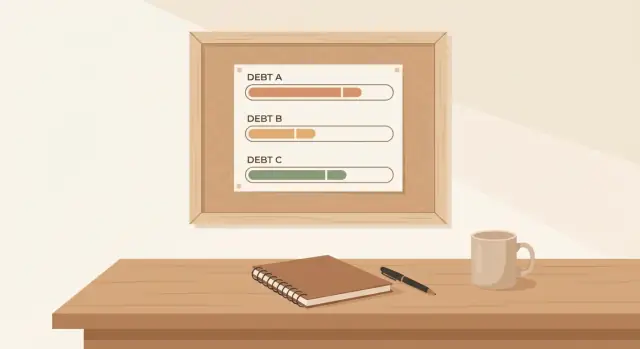
Build a debt payoff progress wall to enter debts and payments, see simple progress bars, and stay motivated with clear weekly updates.
Debt payoff can feel like pushing a heavy cart uphill. You make a payment, you feel proud, and then you check the balance and it barely moved. That gap between effort and visible results is what makes people quit.
A few normal things create that “nothing is happening” feeling. Interest adds back part of what you paid (especially on credit cards). Your payment might post after the statement closes, so the app still shows the old number. And when the balance is big, early progress looks tiny even when you’re doing everything right. Fees or new charges can also hide progress if you’re not watching.
Spreadsheets and banking apps don’t help much with motivation. They’re accurate, but they usually show debt as one cold number. When your balance drops from $8,214 to $8,059, your brain reads it as “still $8k.” Even a good debt payoff tracker can feel like homework if it’s tucked away in a file you rarely open.
A debt payoff progress wall changes what you notice day to day. Instead of asking “Am I done yet?”, you see “I moved the bar again.” That small visual win keeps your focus on the actions you control: making the payment, avoiding new charges, and staying consistent.
It’s especially helpful for solo payoffs (simple and private), couples (shared visibility and fewer misunderstandings), and families (one clear plan everyone can see).
If you’ve been paying but not feeling progress, the problem often isn’t your plan. It’s the feedback loop.
A debt payoff progress wall is a visual tracker you keep somewhere you’ll actually see it. You list each debt, record the payments you make, and fill in a progress bar as the balance goes down. That’s it: debts, payments, and simple bars.
The goal isn’t a perfect system. It’s making progress easy to notice, even in weeks when the numbers barely move.
It’s a quick motivation tool you can update in minutes. It gives you a clear “Where am I now?” view without opening spreadsheets or digging through multiple accounts.
It’s not a strict budget, a transaction-tracking app, a scorecard to beat yourself up, or a complicated plan with a dozen categories.
Create one row (or card) per debt with the name, starting balance, and a bar that fills as you pay it down. Under that, keep a simple payment log so you trust what you’re seeing.
For most people, weekly updates work better than daily updates. Daily can turn into obsessing. Weekly creates a steady rhythm: you record what happened, fill the bar, and move on.
Example: You have a credit card at $2,000, a car loan at $9,500, and a student loan at $18,000. On Sunday, you log the payments you made this week and color in the bars. Even if the student loan bar barely changes, seeing the credit card bar fill faster helps you keep going.
A debt payoff progress wall works only if you notice it and can update it without effort. Don’t aim for “perfect tracking.” Aim for something you’ll still use when you’re tired, busy, or annoyed at money.
Choose the simplest option that fits your life right now:
Placement beats willpower. Put it where you naturally pause for 30 seconds, not where it “should” go.
Good spots include inside a closet door, near your desk, on the fridge, or by where you open mail. If you use a digital version, make it easy to reach (for example, pinned in your notes or planner).
Pick one update day and time and treat it like a short reset, not a budgeting marathon. Sunday night works well for many people.
Before you hang it up, decide on privacy. Use lender nicknames (“Card A”), keep exact dollar amounts on a smaller note behind the main page, or place it inside a cabinet. The best wall is the one you feel comfortable keeping up all month.
Start with what you can confirm today, not what you wish you had organized. The wall stays useful because it stays easy.
Write down each debt as a single line. You only need a few details:
If your statements are messy, use your best recent number and round to the nearest $10 or $50. The point is consistency, not perfect pennies.
When you make a payment, your balance might not match exactly because interest posts later or your statement closes on a different day. That’s normal. If your wall says $1,240 and your portal says $1,227, pick one rule (like “use statement balance”) and stick with it.
Should you include a mortgage or student loans? Use a simple rule: include anything you plan to actively pay off faster than the minimum in the next 12 months. If the mortgage is just “pay as scheduled,” keep it off the wall so the chart stays motivating. Student loans can go either way: include them if you’re attacking them, skip them if they’re on autopay for now.
Finish by writing one total debt number as your baseline. No shame, no commentary, just a starting line.
Example: You list “Visa: $3,450, 24% APR, $95 min” and “Car loan: $12,800, 6.9%, $320 min,” then add “Total: $16,250.” That total gives the bars meaning right away.
The wall only stays motivating if you believe it. The easiest way to trust it is to log payments the same way every time, right after you make them.
Use one line per payment. Keep it boring and consistent:
Extra payments are great, but they can muddy the picture if you don’t label them. If you make a normal payment plus an extra amount, log them as two lines (or one line with a clear “extra” note). That way you can see what was automatic versus what you chose on purpose.
Refunds, chargebacks, and reversals happen. Don’t erase the original payment. Add a new line with a negative amount (for example, -$50) and note why.
If you pay from multiple accounts, log it the same way and add the account name in the note. Consistency matters more than detail.
Your bars should answer one question at a glance: “Am I closer than last week?” If you need to do math to feel progress, the wall stops working.
Pick one bar style and stick to it across all debts. Some people prefer “percent filled” because it feels like leveling up. Others prefer “dollars remaining” because it stays concrete when interest makes the payoff date fuzzy. Either is fine, but don’t mix styles.
Keep colors simple. Give each debt one color and reuse it everywhere (bar, label, payment notes) so you can scan fast.
The most common mistake is bar sizing. If one huge loan dominates the page, smaller debts can feel invisible. A simple fix is equal-length bars for every debt, filled by percentage. That way a $400 card and a $14,000 loan both “count” when you make a payment.
To keep motivation from dropping halfway through, add small milestones. Mark 25%, 50%, and 75% on each bar so you get more wins without waiting for a payoff day.
Example: A $900 credit card that’s 40% paid off often feels more exciting than “$540 left” on a stressful day. The milestone ticks make progress easier to notice.
The best payoff order is the one you’ll stick with. The wall helps because it turns “someday” into something you can see, so choose a method that makes progress feel real.
Snowball means you pay off the smallest balance first (while paying minimums on the rest). You get a quick win, and that win often fuels momentum.
Avalanche means you pay off the highest interest rate first. It usually saves more money over time, but the first “fully paid” moment can take longer.
On the wall, snowball tends to fill and finish more bars sooner. Avalanche can look slower at first, but you know you’re hitting the most expensive debt.
If two debts feel equal, use a tie-breaker: pick the one that will be gone in the fewest payments, or the one with the highest minimum payment. Clearing it frees cash you can roll into the next bar.
Life will interrupt your plan. When you have a rough month, don’t scrap the system. Keep the same order, but temporarily reduce the extra payment amount. If you planned $300 extra but can only do $50, the bar still moves, and the habit stays alive.
Pick one day and time and treat it like taking out the trash. Not exciting, but it keeps everything clean.
Once a week, do a quick reset:
Then give yourself a small reward that doesn’t undo your progress: a long walk with a podcast, an at-home movie night, a coffee you already planned for, or 30 minutes of guilt-free downtime.
Some weeks will look like “no progress.” That doesn’t mean you failed. If you paid the minimums, kept the lights on, and didn’t add new debt, that week did its job. Write a simple note like “Stability week. No new debt.” It keeps you from quitting just because the chart didn’t jump.
When you finish a debt, choose one approach and stick with it. If you need momentum, leave the empty space and label it “PAID OFF” for a month. If clutter stresses you out, remove it right away and expand the remaining bars.
Most people quit for the same reasons: the wall stops feeling honest, or it starts feeling like homework.
One common issue is pretending interest doesn’t exist. If your wall shows only payments, your balance can drop slower than you expect, and that surprise can feel like failure. You don’t need complex math, but you do need a monthly reality check (even if it’s just updating to the statement balance).
Another problem is making the bars too fancy. When every debt has extra colors, tiny milestones, and mini-bars, updates take longer than the payment itself. If updating takes more than a few minutes, you’ll start skipping it, then avoiding it.
Trust also breaks when you keep changing the rules. Switching categories midstream (like relabeling debt because it feels nicer) makes totals feel slippery. Once you doubt the total, the wall loses its power.
Finally, comparison kills motivation. Your wall is a private scoreboard. Comparing your pace to someone with a different income, rent, or family costs will discourage you even when you’re doing the right things.
A simple way to avoid these traps:
Example: If you paid $200 but the balance only dropped $140, write the new balance anyway. That honesty is what makes the wall motivating.
Before you hang the wall and promise yourself you’ll update it, do a quick pass to make sure it stays easy.
Stand a few steps away. Can you instantly tell what’s happening without squinting? If not, make the bars thicker, use fewer colors, and write bigger numbers. Clarity beats decoration.
Final checks:
A helpful test: imagine you miss a week. Could you catch up in 5 minutes? If not, simplify. Combine tiny debts into one line called “small balances” until they’re gone, or stop tracking interest and fees separately.
Example: If you have three cards and one personal loan, pick one “next payment” card and write the exact amount you plan to send this week. When you do it, update the log the same day.
Here’s a realistic month. The goal isn’t perfect math. It’s clear movement you can see.
At the start of the month, you list four debts (round numbers are fine):
| Debt | Starting balance | Minimum | Extra target |
|---|---|---|---|
| Credit Card A | $1,200 | $35 | $100 |
| Credit Card B | $3,400 | $80 | $0 |
| Car loan | $9,800 | $295 | $0 |
| Personal loan | $2,600 | $120 | $0 |
You decide Credit Card A gets the extra $100 because it’s small and you want an early win. You draw four bars, label each with the starting balance, and fill them in as balances drop.
After week 1, your payment log shows:
Now you update the wall. Credit Card A’s bar gets a noticeable chunk filled. The other three bars move a little, which matters because it shows consistency.
Week 2, a surprise expense hits: a $240 car repair. Instead of giving up, you adjust for one week. You still pay minimums, but you pause the extra $100. On the wall, you write: “Repair week, minimums only.” That keeps the story honest, so the wall stays useful.
By day 30, “good progress” looks like this: minimums were paid on time, Credit Card A is down by a few hundred dollars (enough to clearly change the bar), and the other debts are slightly lower. The bigger win is trust. You can point to the wall and see that even with one rough week, you kept moving forward.
Build the first version today. A messy first draft beats a perfect plan you never start.
Keep your rules small: one place to record a payment, one place to see the bars, and one day each week to update.
If you want a digital version, keep it to the minimum set of screens: a debts list, a payments log, and a dashboard with one bar per debt plus a monthly total.
If you decide to build a small tracker app, Koder.ai (koder.ai) can help you create a simple web or mobile app by describing it in plain English. Its snapshots and rollback can be useful while you experiment with the layout, and source code export helps if you want to keep the project moving elsewhere later.
Your next step is small: pick paper or digital, create the first draft, and schedule one weekly update. If it’s easy to update, you’ll keep using it.
It’s a visual tracker you keep somewhere you’ll actually see it. You write each debt, log payments, and fill a simple bar as the balance drops so progress is easier to notice week to week.
Because interest and timing can hide your effort. Payments may post after a statement closes, interest can add back part of what you paid, and big balances make early progress look tiny even when you’re consistent.
Weekly updates are the sweet spot for most people. It’s frequent enough to stay motivating, but not so frequent that you start obsessing over daily balance changes.
Use what you can confirm today: debt name, current balance (rounding is fine), interest rate if easy to find, and minimum payment. The goal is a wall you’ll keep using, not perfect pennies.
Pick one rule and stick to it, like always using the statement balance or always updating on the same day each month. Small differences happen because interest posts later or statements close on different dates, and that’s normal.
Include anything you plan to pay faster than the minimum in the next 12 months. If you’re just paying a loan as scheduled and it makes the wall feel stuck, leave it off so the wall stays motivating.
Use one line per payment with the date it left your account, the amount, and the debt name as written on the wall. Logging right after you pay keeps the wall believable, which is what makes it motivating.
Equal-length bars filled by percentage are usually easiest to read, especially when debts are very different sizes. Add small milestone marks like 25%, 50%, and 75% so you get more “wins” before a payoff day.
Snowball pays off the smallest balance first for quicker wins, while avalanche targets the highest interest rate first to save more money over time. Choose the one you’ll stick with, because consistency matters more than the perfect method.
Yes, if you keep it minimal: a debts list, a payments log, and a screen that shows one bar per debt plus a total. If you want to build it, Koder.ai can help you create a simple web or mobile tracker by describing it in plain English, and features like snapshots and rollback are handy while you tweak the layout.