

Dec 10, 2025·7 min
Book club vote for next book: choices, votes, winner
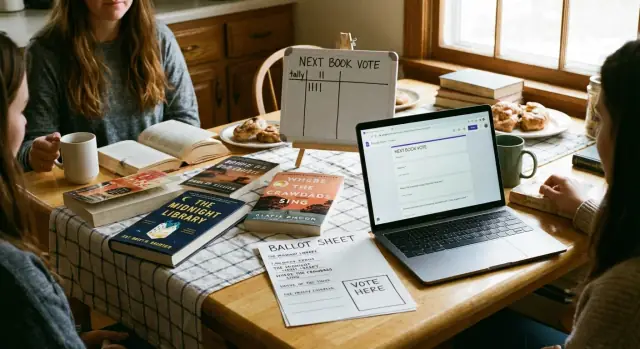
Set up a book club vote for next book with clear options, simple rules, automatic reminders, and an instant winner announcement your group will trust.
Set up a book club vote for next book with clear options, simple rules, automatic reminders, and an instant winner announcement your group will trust.
A book club vote sounds simple until it happens in a group chat. People reply at different times, messages get buried, and someone inevitably asks, "Wait, what are we voting on again?" What should be a quick decision turns into a side debate about the process.
Most mess comes from three things: unclear options, unclear rules, and a flexible deadline. When any of those are fuzzy, people fill in the blanks with their own assumptions. That's when the vote stops feeling fair.
The same friction points show up again and again: ties nobody planned for, late votes that change the outcome after it felt settled, new options added mid-vote, accidental double-voting (emoji plus message plus "my top 3 are..."), and quieter members feeling like the loudest voices picked the book.
Even the word "automatic" can mean different things. For some clubs, it just means votes are in one place and the totals update. For others, it also means the poll closes on time and a clear winner message appears where everyone can see it. If your club is used to informal chat voting, even basic structure can feel like a big shift, so define what you're actually trying to automate.
Before you start, decide where you want to land on speed vs fairness. Speed usually means one clear question and a short deadline. Fairness means a bit more structure: a fixed shortlist, a tie plan, and sometimes a method that takes second choices into account.
The simplest drama-reducer is agreeing on the rules in one short message before anyone votes: the final list, when voting closes, how you'll count, and what happens if there's a tie. When the process is clear, the winner feels earned, even for people whose pick didn't win.
A good vote starts before anyone clicks "vote." If the options feel mismatched, the result feels random, and the argument shifts from the books to the fairness of the choice.
Keep the menu small. Three to six books is usually the sweet spot: enough variety for different tastes, but not so many that everyone picks something different and nothing wins cleanly.
Decide where the choices come from, then stick with that method for a few rounds so it feels consistent. A few common approaches: a monthly theme (like "short mysteries"), open nominations with a hard cutoff, or a rotation where each member gets a turn to propose one option.
Whatever method you use, present each book with the same basic facts so people can compare quickly: title and author, page count (or audiobook length), format options, a one-line genre or vibe, and content notes if your group uses them.
Bias also sneaks in through wording and ordering. "A hilarious modern classic" will beat "a slow, thoughtful novel" even if both are true. Use plain descriptions, keep them about the same length, and avoid always listing your favorite first. Shuffle the order, rotate it, or sort alphabetically.
Example: if your group is doing a "busy month" theme and you offer one 120-page novella, one 900-page epic fantasy, and one dense philosophy book, the vote is really about time, not taste. Instead, offer four options all under 350 pages, all available as audiobook, and all within the same general mood. Now people are choosing what they want to read, not what they can survive.
Voting is fun until someone thinks the rules changed mid-way. The fix is boring but effective: decide the rules first, write them once, and stick to them.
Start with the voting method. One-person-one-vote is the simplest: everyone picks a single book and the most votes wins. It works well when the shortlist is already close in popularity.
If your club often splits across genres, consider ranked choice voting. Instead of picking one title, each person ranks their top picks (often top 3). This tends to produce a winner most people can live with, even if it wasn't their first choice, and it reduces the "we lost again" feeling.
You don't need a long policy document. You need a few decisions made in advance:
Handle ties up front. A coin flip is quick but can feel random. A runoff between the tied books is usually the easiest for people to accept, as long as it's time-boxed (for example, 24 hours). A host tiebreak can work too, but only if everyone agrees to it before voting starts.
A realistic scenario: you have 12 members. You allow late joiners to vote only if they attended the last meeting, to keep it fair. Voting opens Monday 9:00 AM and closes Wednesday 9:00 PM local time. The top two books tie. You run a 1-day runoff with just those two titles. No debate, no re-litigating the shortlist, just a clean second vote.
The goal isn't perfection. It's a process everyone understands, so the outcome feels legitimate.
The best setup is the one everyone will actually use. That usually means one poll or form, one official shortlist, and one clear deadline.
A basic poll works when you have a short list and you only need one pick. A form is better when you want ranked choice, optional comments, or you need to prevent double voting.
Only collect what helps you count votes and explain the result later. A consistent name or handle helps you spot duplicates. Then capture either one choice or a ranked list. If it matters for your club, add one optional note like "already own this" or "not available in my country," plus an optional format preference.
Lock the choices. If people can add nominees inside the poll, you end up with spelling variants and surprise entries that feel unfair.
Put the nominees in a single place and treat it as the source of truth. List title, author, and one detail that helps people compare (page count, genre, and availability). If a title drops out (not available, too long), update the list and tell everyone before voting opens.
A predictable rhythm prevents last-minute arguments:
If you automate anything, start with auto-counting and a ready-to-post winner message. Manual counting is where mistakes (and suspicion) creep in.
A smooth vote is mostly about timing and clarity. Set dates first, then run the whole thing like a mini event: nominate, vote, close, announce.
Use one channel for the official info (email, group chat, or a pinned post) so nobody misses the rules.
Decide what counts as an eligible vote (members only, guests allowed, one ballot per person). If someone changes their mind, allow edits only until the deadline.
Example: you open voting Monday morning, send one reminder Wednesday night, and close Thursday at noon. On Thursday afternoon you post the winner plus "First meeting: Jan 30, discuss chapters 1-6." People stop debating because the plan is already set.
A smooth vote is less about the tool and more about removing doubt. If people can vote in 20 seconds, understand the rules, and see how the winner was picked, you get fewer complaints and more participation.
Anonymous voting works best when your group has strong opinions and you want honest picks without side chats. It can also boost turnout because no one feels judged for choosing the "easy" read.
Named voting works when you want accountability, or when the club is small and friendly enough that transparency feels normal. It also helps if you need to confirm membership.
A simple middle ground is collecting names but sharing results without names. That keeps one-person-one-vote while avoiding public pressure.
You don't need heavy security. You just need light friction that stops accidental repeats. Depending on your group, that might be one response per account sign-in, a quick duplicate scan before announcing, or the honor system plus a reminder: "one vote each." Pick one approach and say it upfront.
Late votes are another common trigger. Decide before you open the poll: either refuse late votes, or accept them but clearly label them "late" and don't mix them into the final count. For example: "Poll closes Sunday 8:00 pm Eastern. Votes after that are recorded but won't change the winner."
Accessibility matters more than people expect. Make the poll mobile-friendly, keep text readable, and avoid long descriptions stuffed into tiny fields. If your members span time zones, include the closing time with the date and at least one conversion.
Example: if Priya in London and Sam in Seattle both see "closes Friday," they may assume different Fridays. "Closes Fri, Mar 8, 8:00 pm Eastern (Sat 1:00 am UK)" prevents confusion.
Most book club fights aren't about the book. They're about the process feeling messy or unfair. Prevent a few common slip-ups and the vote stays friendly even when people disagree.
Offering too many options is the classic mistake. When the list is long, people skim, vote randomly, or stop caring.
Changing the rules once voting has started is another. Even small tweaks (like extending the deadline because one person missed it) can feel like favoritism. If you need flexibility, say so before the poll opens.
Ties cause drama when nobody knows what happens next. If you wait until a tie happens to decide, the tie-break can look personal.
Vague nominations create confusion later. Someone votes for "Dune" thinking of the print edition, another means the audiobook, and a third means a different translation. When the group meets, it feels like a bait-and-switch.
Finally, announcing results without showing how you counted can make people suspicious, even if you were fair. You don't need to show a spreadsheet. You just need enough detail that the outcome is easy to trust.
If you want a short "no-drama" standard, it's this: keep choices tight and clearly described, lock the rules and deadline before the first vote, write down a tie-break rule in one sentence, and share a short count summary when you announce the winner.
Example: "We have a tie at 9 votes each. We'll run a 24-hour runoff with only these two titles, same deadline rules." That one line saves a lot of back-and-forth.
A book club of 9 people wants to choose the next read without ending in "we split the vote again." Members are in mixed time zones (US, UK, India), so the host opens voting for 48 hours and sets one clear deadline everyone can convert: 9:00 pm UTC on Wednesday.
They pick 5 nominees that are different enough to be interesting, but similar enough to compare:
To avoid split votes, they use ranked choice voting. Each person ranks the books 1 to 5. If no book gets 5 first-choice votes (a majority), the lowest is removed and those ballots move to the next ranked choice.
Here's how the tally plays out.
| Round | A | B | C | D | E | Notes |
|---|---|---|---|---|---|---|
| 1 (first choices) | 3 | 2 | 2 | 1 | 1 | No majority. Remove E (lowest). |
| 2 | 3 | 3 | 2 | 1 | - | E’s 1 vote transfers to B. Remove D. |
| 3 | 4 | 3 | 2 | - | - | D’s 1 vote transfers to A. Remove C. |
| 4 (final) | 4 | 4 | - | - | - | One of C’s voters did not rank A or B, so that ballot is “exhausted.” Tie. |
They planned for ties before voting opened: if the final round is tied, the winner is the tied book with more first-choice votes in Round 1. That makes Nominee A the winner (3 first-choice votes vs B’s 2).
Final announcement message the host posts:
Voting is closed.

Winner: Nominee A (final round tied 4-4; tie-break was higher first-choice votes).
Runner-up: Nominee B.

Next meeting: Tuesday, March 12 at 7:00 pm UTC.
Reading pace: ~70 pages per week (we’ll discuss Part 1 next time).

I’ll share the discussion questions two days before.
Because the rules were set up front and the tie-break was mechanical, the result feels clear even with a last-round tie.
A smooth vote is usually decided before anyone clicks "vote." Five minutes of prep now can save you a week of group chat debates later.
First, lock the nominees. Put the final list in one place everyone can find and keep it stable until the poll closes. If someone suggests a late addition, thank them and park it for next month.
Next, write the rules in plain language. If people have to ask "how does this work?" the poll is already losing trust. Keep the method and tie-break to one sentence, and reuse the same sentence everywhere.
Before you hit send, make sure:
One small detail worth deciding: what do you do about non-voters? Are they treated as "no preference," or do you require a minimum number of votes? If it matters for your group, include it in the rules message.
If you want to reduce last-minute work, draft the winner message while you set up the poll. You can even pre-write two versions: one for a clear win, and one for a tie.
Once your group has a voting flow that feels fair, the next win is saving everyone time. Good automation is intentionally plain: fewer reminders to chase people, fewer counting mistakes, and a result that feels official.
Start with the steps that cause the most friction: scheduled reminders, auto-totals when the poll closes (including tie-breakers), and a winner post you can copy and paste.
A simple archive also helps more than you'd think. Save the same fields each month: date, shortlist, total votes, and the winner. If you use ranked choice, save the final round too. When someone says "we already read that," you can answer in seconds.
If your club wants a tiny custom tool instead of spreadsheets and manual tallying, a chat-built app can cover the basics: store nominees, accept votes, timestamp submissions, and generate a clean results summary. Koder.ai (koder.ai) is one option for building that kind of lightweight voting app from a prompt, with the ability to host it or export the source code later.
The goal isn't fancy features. It's fewer follow-ups, fewer mistakes, and a winner announcement nobody has to debate. "}
Write one short “rules block” and post it before anyone votes: the final shortlist, how people vote, the exact close time with time zone, how you count, and what you’ll do in a tie. If everyone can point to the same message, most confusion disappears.
Keep it to three to six options. Fewer than three feels limiting, and more than six increases split votes and makes people skim instead of choosing thoughtfully.
Lock nominations with a clear cutoff, then freeze the shortlist during the voting window. If someone suggests a great late pick, acknowledge it and save it for next month so the current vote still feels fair.
Use one-person-one-vote when your shortlist is already pretty aligned and you mainly need a quick decision. Use ranked choice when your group often divides by genre, because it helps find a winner most people can accept, not just the loudest minority favorite.
Pick a tie-break rule before voting opens and keep it mechanical. A short runoff between the tied titles is usually easiest to accept, but if time is tight you can use a pre-agreed tiebreak like “most first-choice votes wins.”
Set a firm deadline and stick to it. The simplest default is that late votes are recorded but do not change the result, because changing the outcome after it “felt settled” is what triggers frustration.
Anonymous voting reduces pressure and can increase participation when opinions are strong. Named voting helps prevent double-voting and is simpler for small groups, and a middle option is collecting names for validation but sharing only totals publicly.
Keep the nominee descriptions neutral and consistent, using the same facts for every option like page count or audiobook length, format availability, and a one-line vibe. Also avoid always listing your favorite first, because order and hype wording can quietly steer the vote.
Use one official place for the shortlist and one official place to vote, then announce the winner with the totals and the next meeting plan in the same message. When people understand how the result was counted and what happens next, they stop re-litigating the choice.
Build something small that matches your exact rules: store a fixed shortlist, accept one ballot per member, timestamp submissions, close automatically at a set time, and generate a ready-to-post results summary. A vibe-coding tool like Koder.ai can create that kind of lightweight web app from a chat prompt, and you can export the source code later if you want more control.