

Oct 23, 2025·7 min
AI-generated code reviewable: from prototype to team handoff
Make AI-generated code reviewable by standardizing folders, naming, and written invariants so a human team can safely take over and ship changes.
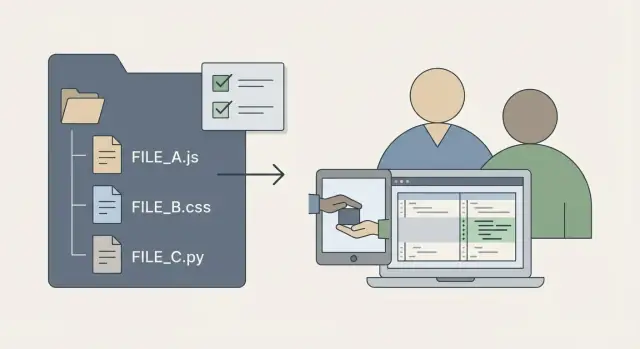
Make AI-generated code reviewable by standardizing folders, naming, and written invariants so a human team can safely take over and ship changes.
AI prototypes often succeed for one reason: they get you to “working” fast. The trouble starts when “working” needs to become “maintainable by a team.” A prototype can tolerate shortcuts because the same person (or the same chat thread) holds all the context. A team can’t.
AI-generated code can also feel harder to review than human-written code because the intent isn’t always visible. Human code usually leaves a trail: consistent patterns, repeated choices, and a few comments that explain why something exists. AI output can be correct, but still mix styles, shift patterns between files, and hide assumptions in places reviewers don’t expect.
The goal is predictability: predictable places, predictable names, predictable behavior. When a teammate can guess where something lives, what it’s called, and how it behaves, review turns into a quick check instead of a detective story.
What typically goes wrong when a prototype becomes a team project:
userId vs userid vs user_id), making search unreliable and bugs easier to miss.Small inconsistencies multiply maintenance time because they force repeated decisions. If every new screen has a slightly different folder location, component name, and data-fetching style, reviewers can’t build a stable mental model. They have to re-learn the code every time.
A realistic example: a non-technical founder uses a vibe-coding tool to spin up a simple CRM. It demos well, but when a small team takes over, they find three different ways of storing auth state, two naming styles for React components, and business rules spread across UI code and backend handlers. Nothing is “broken,” but every change feels risky because nobody knows which patterns are the real ones.
Handoff gets easier when you reduce choices. Teams move faster when the codebase quietly tells them, consistently, what to do next.
“Reviewable” means a new developer can open the repo, find the right place to change, make the change, and confirm nothing else broke. That’s basic, and it’s also what many AI prototypes miss.
To make AI-generated code reviewable, focus less on cleverness and more on how safely a human can touch it. Reviewability is about lowering the risk of change.
When a teammate reviews a pull request, they’re trying to answer a few questions quickly:
Small diffs help, but “small” isn’t only line count. It also means stable boundaries: a change in one area shouldn’t require touching unrelated files.
You don’t need perfection. You need conventions, a little documentation, a few tests, and guardrails that prevent future drift.
A reviewer feels safer when they can quickly spot:
Example: you built a React frontend and a Go API. The prototype works, but the “create customer” flow is spread across UI code, API handlers, and database calls with slightly different field names. Making it reviewable means aligning those names, keeping the API boundary clear, and writing down the rules (for example, “email must be unique” and “status can only be active or paused”).
Don’t aim for rewriting everything until it looks like a textbook project. Handoff-ready code is clear, consistent, and safe to change, even if it’s not the prettiest version yet.
A team can forgive imperfect code. What they struggle with is not knowing where anything lives. If you want AI-generated code to be reviewable, make the project easy to scan: a small set of top-level folders, consistent names, and one obvious home for configuration.
Keep the top-level map stable as the app grows. Many handoffs fail because new folders appear for every experiment. Instead, separate three concerns: app composition (screens, routes), core business rules, and infrastructure.
Here’s one practical pattern you can adapt (web app example):
/
  /app            # routes/pages and UI composition
  /core           # domain logic: entities, rules, use-cases
  /ui             # reusable components, styles, design tokens
  /infra          # db, api clients, queues, auth adapters
  /config         # env schema, feature flags, app settings
  /scripts        # local tooling, seed data, one-off tasks
  /docs           # handoff notes, invariants, decisions
If your first version was generated quickly, keep that separation visible. Put replaceable generated modules under something like /generated, and keep human-edited modules under /core or /app. The point is to avoid accidental edits to code you might regenerate later.
Before handoff, do a quick navigation test with a teammate (or your future self). Ask where the login UI lives, where authorization rules live, where database access is defined, where API base URLs and feature flags are set, and where “special” scripts live.
If any answer starts with “it depends” or “search for it,” adjust the structure until each topic has a single, boring home. That boring feeling is what makes maintenance fast and safe.
A naming convention is a promise: a reviewer should be able to guess what something is, where it lives, and how it’s used before opening the file.
Start with file names and stick to one style across the repo. A simple default is: folders in kebab-case, React components in PascalCase, and non-component TypeScript files in camelCase. Break the rule only when the ecosystem expects it (for example, standard Flutter file conventions or standard files like README).
Names should reveal intent, not implementation:
BillingSummaryCard.tsx (what it represents)StripeCard.tsx (bakes in a vendor choice)RenderBilling.tsx (describes how, not why)Be strict with vague buckets. Files called utils, helpers, or common become junk drawers fast, especially when code is generated in bursts. If you need shared code, name it by scope and purpose, such as auth/tokenStorage.ts or billing/billingCalculations.ts.
Feature folders describe the user problem space. Technical folders describe cross-cutting infrastructure. Mixing them hides boundaries.
A practical split is features like billing, onboarding, inventory, and technical areas like api, db, routing, design-system. When you have multiple clients (web, server, mobile), keeping the same feature names across layers makes changes easier to trace.
Use this short rubric in code review:
Rename early. Renames are cheap during handoff and expensive after the team builds on top of confusion.
An invariant is a rule your app depends on to stay correct, even as features change. AI-generated code often “works” because the generator assumed a set of rules, but those rules may live only in prompts or in someone’s head. Write them down so reviewers know what must not quietly shift.
Good invariants are boring, specific, and testable. Avoid vague statements like “validate inputs.” Say exactly what’s allowed, who can do what, and what happens when the rule is broken.
Most handoff pain comes from the same areas:
If you can turn the sentence into a unit test or an API test, it’s the right level.
Put invariants where people naturally look during review:
Avoid hiding invariants in long docs nobody opens. If it doesn’t show up during normal PR review, it will be missed.
Phrase each invariant with scope, rule, and enforcement point. Example: “For all endpoints under /api/projects/:id, the requester must be a project member; enforced in auth middleware and checked again on task updates.”
When an invariant changes, make it explicit. Update the doc line, point to the code locations that changed, and add or update a test that would fail under the old rule. Otherwise the team tends to keep half the old behavior and half the new one.
If you’re using a vibe-coding platform like Koder.ai, one useful handoff step is to ask it to list the invariants it assumed while generating the app. Then turn that into a small set of testable rules the team can review and keep current.
A handoff isn’t the same as “it runs on my machine.” The goal is to make the project easy to read, safe to change, and predictable when someone new opens it.
Start by freezing scope. Pick a date and a short list of what must be stable (core screens, key flows, integrations). Also write down what’s explicitly out of scope so nobody keeps piling on features while you’re trying to clean things up.
Then do cleanup before adding anything new. This is where reviewability starts to appear: the codebase behaves like a product, not a demo.
A practical sequence:
Keep the smoke test plan small but real. For a React app with a Go API and Postgres, that might be: sign in, create a record, refresh, confirm it persists, and confirm a restricted action fails.
Do one review cycle that focuses on readability, not features. Ask a teammate to spend 30 minutes answering: “Can I find things?” “Do names match behavior?” “Are the invariants obvious?” Fix what slows them down, then stop.
Before handoff, do a “fresh eyes” test. Ask someone who didn’t build the prototype to open the repo and narrate what they think it does. If they can’t find starting points quickly, the team will pay that cost on every change.
A simple rule: a new developer should be able to locate the main entry points in under two minutes. That usually means a clear README that names the one or two places to start (web app entry, API entry, config), and those files aren’t buried.
Also check review size. If key modules require endless scrolling, reviewers stop catching problems. Split long files so each one has a single job and can be understood in one sitting.
A short handoff checklist:
validateUser validates, it doesn’t also write to the database.Maya is a non-technical founder. She built an MVP by describing the product in chat: a simple CRM for a small services business. It works: login, customers, deals, notes, and a basic admin screen. After a few weeks, she hires two developers to take it from “works on my laptop” to something the business can rely on.
On day one, they don’t start by rewriting. They start by making the code reviewable. Their first move is to map the app into two buckets: core modules (things every feature depends on) and features (screens and workflows users touch). That gives them a place to put decisions, and a place to put change.
They agree on a simple feature map: core (auth, database access, permissions, logging, UI components) and features (customers, deals, notes, admin).
Then they adjust the folders to match that map. Before, files are scattered, with mixed naming like CustomerPage.tsx, customer_view.tsx, and custPageNew.tsx. After, every feature has one home, and core code is clearly separate. Reviews get faster because pull requests tend to stay inside one feature folder, and core changes become obvious.
A small naming rule does most of the work: “folders are nouns, components are PascalCase, functions are verbs, and we don’t abbreviate.” So custPageNew.tsx becomes CustomerDetailsPage.tsx, and doStuff() becomes saveCustomerNote().
They write down one key rule that must always be true and place it in a short INVARIANTS.md inside the feature folder.
Example invariant for the CRM:
Only the deal owner or an admin can edit a deal. Everyone else can view it, but can’t change status, value, or notes.
That sentence guides backend checks, database queries, and frontend UI states. When someone later adds “bulk edit,” reviewers know exactly what must not break.
After one week, the code isn’t perfect, but the handoff is real:
AI can get you to a working prototype fast. The problem is that “working” often depends on hidden assumptions. When a team touches it later, small changes break things in surprising places.
One common mistake is refactoring everything at once. Big cleanups feel satisfying, but they make it hard to see what changed and why. Set boundaries first: decide which modules are stable, where new code is allowed, and what behavior must not change. Then improve one area at a time.
Another frequent issue is duplicate concepts with different names. AI will happily create both UserService and AccountManager for the same job, or plan vs pricingTier for one idea. Pick one term for each core concept and rename consistently across UI, API, and database.
Hidden rules are also a major source of brittleness. If the real business logic lives in prompts or chat history, the repo becomes hard to maintain. Put the rules in the codebase as clear comments, tests, or a short invariants doc.
Catch-all folders like shared, common, or utils quietly become junk drawers. If you need shared modules, define what they own (inputs, outputs, responsibilities) and keep them narrow.
Mixing business rules into UI code is another trap. A quick conditional in a React component becomes the only place a pricing rule exists. Later, the mobile app or backend disagrees. Keep business rules in one layer (often backend or a domain module) and have the UI call it instead of re-implementing it.
Finally, brittle code often comes from skipping review norms. Teams need small diffs, clear commits, and clear intent. Even if a generator produced the change, treat it like a normal PR: keep scope tight, explain what changed, and make it easy to verify.
Treat handoff as the start of maintenance, not the finish line. The goal stays simple: a new person can make a small change without breaking hidden rules.
Turn team preferences into a few written defaults: one folder map everyone follows, one naming style, and one template for invariants. When those rules are agreed upfront, review comments stop being personal taste and become consistent checks.
Keep a “handoff README” that points to the few places that matter: where invariants live, how to run the app, how to add a feature safely, and what not to change without discussion. A new teammate should find answers in under five minutes.
If your workflow supports reversibility, use it. For example, Koder.ai supports snapshots and rollback, which can be a simple safety net before refactors or dependency upgrades. When you’re ready to transfer ownership, exporting the source code from koder.ai gives the team a clean starting point for normal Git-based work.
Start by making the code predictable. Align folder structure, naming, and boundaries so a teammate can guess where things live and how they behave without searching across the whole repo.
Pick one pattern for each recurring job (auth state, data fetching, validation, error handling) and apply it everywhere. The goal is not “best,” it’s “consistent,” so reviewers aren’t relearning the app on every change.
A reviewable codebase lets a new developer find the right place to change, make a small edit, and verify it safely. If changes routinely spill into unrelated files or require guesswork about rules, it’s not reviewable yet.
Use a small, stable set of top-level folders and keep each concern in one obvious home. Separate app composition (routes/screens), core business rules, and infrastructure so navigation takes seconds, not detective work.
Put code you might regenerate under a clear folder like /generated, and keep human-edited code in stable areas like /core and /app. This prevents accidental edits that get overwritten later and makes ownership clear during review.
Choose one convention and enforce it everywhere: consistent casing for folders and files, consistent component naming, and consistent field names across UI, API, and database. Consistency makes search reliable and reduces subtle bugs from mismatched names.
Invariants are the rules that must stay true as the product changes, like permissions, unique constraints, and allowed state transitions. Writing them down turns hidden assumptions into visible checks reviewers can protect.
Keep them where people will actually see them: a short section in the README plus brief notes right next to the code that enforces the rule. If the rule doesn’t show up during normal PR review, it will be forgotten.
Freeze scope first by choosing a small set of core user journeys that must work and what is explicitly out of scope. Then normalize folders and names, delete dead code, add a minimal smoke test checklist, and do one review pass focused on readability only.
Avoid big refactors that touch everything, catch-all folders like utils, and business rules buried in UI conditionals or chat history. Also watch for duplicated concepts with different names and drifting validation/error handling across endpoints and screens.